Tu Ethnic Minority: Inside the World of China's 'Rainbow People' - Origins, Festivals and How to Visit
- Tom Song

- 9 hours ago
- 23 min read
QUICK ANSWER
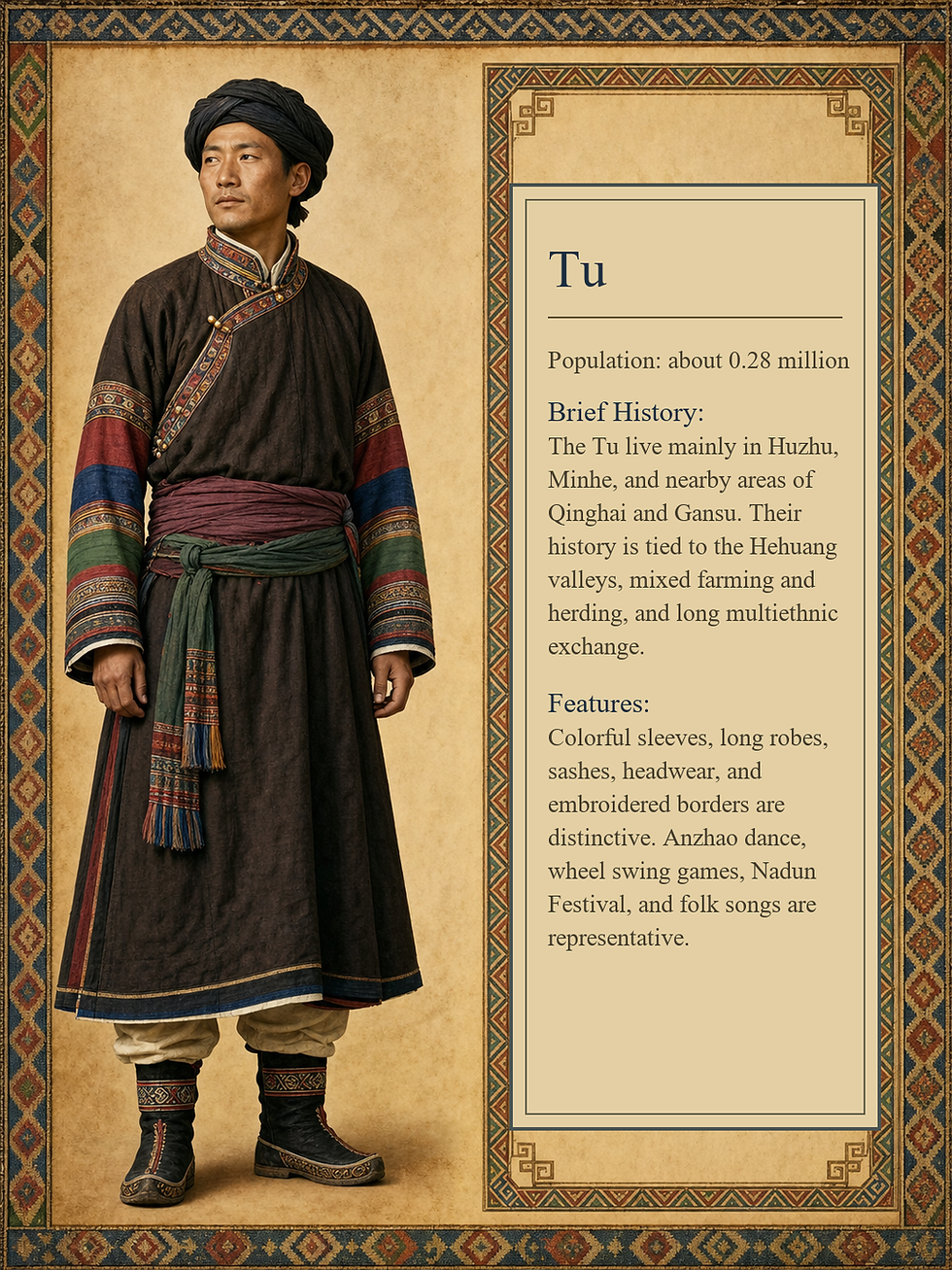
The Tu ethnic minority (Tu zu; self-name Monguor or Chahan Mongguer) is one of China's 56 officially recognised nationalities, numbering 281,928 people at the 2020 national census. About a quarter of them live in Huzhu Tu Autonomous County in Qinghai province, the only Tu autonomous county in China. They speak a Mongolic language, follow Tibetan Buddhism, and are nicknamed the 'rainbow people' for the seven-colour embroidered sleeves Tu women wear.
Ask an experienced China traveller to name the country's ethnic minorities and you will hear Tibetan, Uyghur, Zhuang, Miao, Yi. The Tu ethnic minority almost never makes the list. Fewer than 300,000 people. One autonomous county. No indigenous written script for most of their recorded history. And yet this small nation on the north-eastern rim of the Qinghai-Tibet Plateau hosts what Chinese folklorists routinely call the longest carnival on earth: Nadun, a harvest thanksgiving that rolls from village to village across the Sanchuan plain for 63 consecutive days.
That gap between size and cultural weight is the reason to go. Most minority-culture tourism in China is a 30-minute staged show in a coach car park. The Tu ethnic minority are different, because the things worth seeing here are still doing the jobs they were built to do. Nadun is not a performance; it is how two dozen villages schedule their irrigation, settle their arguments, introduce their young people and thank whatever powers kept the hail off the barley. Tu panshow embroidery is not a souvenir craft; it is the income base for more than thirty village workshops and the reason a resettled mountain village went from 2,600 yuan of annual income per head to 13,100 in seven years.
This guide covers who the Tu ethnic minority are, where they live, what to see of their culture, when to go, and how to do it without turning someone's religious festival into your photo opportunity. Every date, figure and place name below is sourced from government statistics, state media reporting and the national intangible cultural heritage register, and the 2026 festival dates are converted from the lunar calendar at the end. If you are building a trip rather than reading one, the final two sections are the ones that matter.
Who Are the Tu Ethnic Minority? Name, Origins, Population and Where They Live
The Tu ethnic minority is a Mongolic-speaking people of China's north-west whose population was 281,928 at the 2020 national census, concentrated in the Huangshui and Yellow River valleys of eastern Qinghai with a secondary cluster across the Gansu border. The Chinese state classifies them as one of the 56 nationalities; they call themselves Monguor, or Chahan Mongguer, which translates roughly as 'White Mongol'. Tibetan neighbours have historically called them Hor.
The name matters, because it encodes the central unresolved question about Tu origins. There are two mainstream accounts and they are not mutually exclusive. The first traces the Tu to the Tuyuhun: a Xianbei Murong clan that migrated west from the north-east in the early fourth century and established a kingdom on the Qinghai plateau that lasted roughly three and a half centuries until the rising Tibetan Empire absorbed it in 663 CE. Excavations at Tuyuhun-era tombs in Dulan county turned up an early coiled embroidery motif - the 'precious flower roundel' - which heritage researchers cite as evidence that Tu panshow technique was already forming around the fourth century. The second account traces them to Mongol garrison troops who entered the Xining region under the Yuan dynasty and married into the local Hor herding population.
Most contemporary scholarship treats the Tu as a fusion rather than a single bloodline: a core that absorbed Han farmers, Tibetan Buddhists, Mongol soldiers and smaller neighbouring groups over six or seven centuries of contact on a trade and military corridor. That is also the honest way to describe the culture you meet today. A Nadun ceremony will put a masked shamanic tiger fight, a Chinese opera general and a Tibetan Buddhist incense offering on the same threshing floor, and nobody in the crowd finds that strange.
The demographic record is unusually clear. National census counts for the Tu run: 53,272 in 1953; 77,484 in 1964; 159,426 in 1982; 192,568 in 1990; 241,198 in 2000; 289,565 in 2010; and 281,928 in 2020. Two things jump out. First, the population roughly quintupled between 1953 and 2010, driven by falling mortality and the end of a period in which Tu families had strong incentives to register as Han or Tibetan. Second, the 2010 to 2020 figure dipped by about 2.6 per cent - the first recorded decline - consistent with out-migration to cities and with Tu-Han intermarriage registration patterns. A people this small is demographically fragile in a way that a 10-million-strong nationality is not, which is a real argument for visiting while the transmission chain is intact.
Geographically the Tu pattern is described as large concentration, small dispersion. They are registered in all 31 provincial-level administrative regions of China, but the overwhelming majority sit in a compact arc north of the Huangshui river and along the Yellow River in eastern Qinghai. The core is Huzhu Tu Autonomous County. Beyond it, the main clusters are Minhe Hui and Tu Autonomous County, Datong Hui and Tu Autonomous County, Tongren, Ledu and Menyuan in Qinghai, and Tianzhu, Jishishan and Zhuoni in Gansu. Community records also put a few thousand Tu residents in each of Yunnan and Guizhou, the result of twentieth-century labour and marriage migration - a detail that surprises most travellers and matters to us in Yunnan, where a small Tu community lives alongside the 25 nationalities that make the province one of the most diverse in China.
Huzhu deserves the focus it gets. It is the only Tu autonomous county in China, it holds 75,800 Tu residents - 18.9 per cent of the county's 401,600 people and 26.9 per cent of every Tu person in the country - and it markets itself, accurately, as the Homeland of the Rainbow. The county covers 3,424 square kilometres across seven towns, one subdistrict and eleven townships containing 294 administrative villages, and it runs from 4,242-metre peaks in the Qilian ranges down to 2,200-metre irrigated valley floor. That 2,000-metre vertical drop is itself the Tu story: high pasture above, barley and rapeseed below, and a culture built on working both.
Language, Faith and Worldview: What Makes Tu Culture Distinct
The Tu language belongs to the Mongolic branch of the Altaic family and splits into three dialects - Huzhu, Minhe and Tongren - which are different enough that researchers treat them as separate dialect zones rather than accents. For the Tu ethnic minority, language is the clearest surviving record of where they came from. Its basic vocabulary sits close to Mongolian and closer still to the Bonan language. It has no traditional written form. A Latin-based orthography was devised for it in 1979, and in daily practice most Tu people write in Chinese while the monasteries read and chant in Tibetan. The result is a language with Tibetan loanwords layered into its religious register and Mandarin loanwords layered into everything modern - a spoken record of exactly which two civilisations this small nation spent its history between.
Religion follows the same layered logic. The Tu people are overwhelmingly Tibetan Buddhist, with the Gelug school dominant since it spread through the region in the late Yuan and early Ming. Monastic infrastructure is substantial for a population under 300,000: roughly forty Gelug monasteries across Tu areas, the greatest of them Youning Temple in Huzhu, known as the mother of all monasteries north of the Huangshui. Quezang Temple, also in Huzhu, was a Qing imperial foundation and is now a national key protected site. Baima Temple, in Hongya zigou township, dates to the tenth-century revival of Buddhism in the region. If you only visit the folk-culture parks you will miss all three, which is a mistake: the monastic architecture is where Tu art history actually lives.
Under the Buddhism sits something older. Tu culture retains a shamanic substrate that anthropologists have documented for decades: offerings to Tengri, the sky; ovoo cairn worship; a white tiger rite; and the selection of a sacred sheep that is then never shorn or sold. These are not museum pieces. They are performed, and they are the reason Nadun looks nothing like a Buddhist festival despite being organised by Buddhist villages. Add Chinese popular religion - Erlang and Guan Yu both appear as Nadun deities - and Taoist practice absorbed from Han neighbours, and you have a four-source religious system running simultaneously in villages of three or four hundred households.
The economic base shifted the same way the religion did. Tu ancestors were pastoralists; from the late Yuan and early Ming, irrigated farming expanded fast on the valley floor and the Tu became agriculturalists with herding as a secondary activity. That transition is literally enacted in Nadun. One of the core masked plays is Zhuangjiaqi, 'the farming family', in which an old father teaches his reluctant son how to harness a plough - played for laughs, with the son putting the frame on upside down. It is the single most quoted piece of evidence that Nadun encodes a pastoral-to-agricultural memory, and it is still funny in the threshing-yard dust.
Social organisation is where most visitors' understanding breaks down, because it is invisible. Tu society retains strong clan structures in which a clan elder adjudicates disputes and organises ritual obligation. Villages run a qingmiaohui - a 'green seedling association' - that in practice manages far more than ritual. In Sanchuan, the Nadun organisers, elected at the Qingming festival six months before, are the same people who set the order in which fields take irrigation water through the summer. The water rotation and the festival rotation are the same roster. When you watch two villages meet on a threshing floor with drums and a hundred coloured banners, you are watching an irrigation authority renew its working relationships in public.
Material culture completes the picture. The Tu built in rammed earth: the zhuangkuo, a high-walled square courtyard compound with timber carving and brickwork, is the vernacular form and the best-preserved examples sit in the Rainbow Tribe Tu Garden. Dress is the most visible signature - the seven-colour sleeve, stitched in seven silks onto a black cotton gown. Food runs on highland barley in every form: steamed buns, fried twists, and the distilled barley liquor that anchors Tu hospitality. Tu hosts traditionally receive a guest with a fixed sequence of courses, opening with butter tea and fried pastries and closing with hand-pulled noodles. The modern three-cup welcome at the park gate is a compressed version of a much longer code.
Seven Unmissable Tu Cultural Experiences, Ranked
Ranking the cultural experiences of the Tu ethnic minority is a crude instrument, so here is the criterion set used below: how much of the thing is still doing real work in the community, how much a visitor can actually participate rather than watch, and how hard it is to reach. On that basis the Nadun festival leads and the folk-park shows land mid-table, which will surprise anyone whose only reference point is a coach itinerary.
1. Nadun, the 63-day harvest relay - Minhe county, Sanchuan plain. Nadun (literally 'to play') is the largest single reason to travel for Tu culture. It runs from the twelfth day of the seventh lunar month to the fifteenth day of the ninth, moving village by village from the earliest-ripening Lower Sanchuan westward through Middle and Upper Sanchuan, each village taking its turn as host for a day. In 2026 that window is 24 August to 24 October. A day opens with the huishou dance, in which forty to a hundred men of the host village - elders in gowns with fans at the front, boys with willow switches behind - walk out to meet the guest village, form a single line, and rotate through formations with names like Single Snake, Two Dragons at the Pearl and Four Gates. Then the masked plays: Zhuangjiaqi, Sanjiang, Wujiang, Guanwang, Wuguan and the tiger-slaying general. It was inscribed on China's first national intangible cultural heritage list in 2006, and the designated protection unit is the Minhe cultural centre.
2. Tu panshow embroidery - Huzhu county, and Banyan village in particular. Panshow uses a technique no other Chinese embroidery tradition shares: two needles, two threads, working together, the upper needle coiling the surface thread while the lower one stitches it down. The result is dense, raised and almost indestructible, worked in seven coloured silks on black cotton, with the sunflower motif the signature pattern. It entered the national heritage list in 2006 and the national traditional-craft revitalisation catalogue in 2018. What makes it worth travelling for is the economics. Huzhu's Banyan village built a panshow production base in 2017; since then the cooperative reports more than 75,000 orders and around three million yuan of order income, with average artisan earnings up by more than 5,000 yuan a year. There are now over thirty 'qingxiu' embroidery workshops in the county. The national-level representative inheritor, Li Faxiu, has taught more than 800 students; Banyan village's workshop head, Zhang Zhuomashijie, is a provincial-level inheritor. Buying directly from a workshop is the single highest-value thing a visitor can do here.
3. A Tu wedding - best seen at the Rainbow Tribe Tu Garden, and better seen in a village. Tu wedding custom entered the national heritage list in 2006. The sequence includes the bridal lament, the hair-combing ceremony, leaping the fire, and the antiphonal wedding songs known as daola, which local records say were already standard in Tu weddings by the early Ming. The park stages a full run most days and pulls audience members onto the set, which is more fun than it sounds. The most striking element for first-time visitors is the lament: this is a wedding where the bride is expected to sing her grief at leaving, and the singing is not decorative.
4. Lunziqiu, the wheel swing - Huzhu. Take the axle and wheel off a cart, stand the wheel upright, weight the lower wheel with a stone roller, lash a ladder across the upper wheel and hang a rope loop from each end. Two riders sit in the loops, the wheel is pushed, and they spin horizontally above the threshing floor. That is lunziqiu, a Tu invention, listed nationally in 2008 under traditional sports and acrobatics, with Hu Zongxian as its named inheritor. A modern competition version uses a steel rim with ball bearings and coloured streamers, and it was this discipline that performed in the Bird's Nest before the 2008 Beijing Olympics opening ceremony and at the twelfth National Traditional Games of Ethnic Minorities. Skilled riders do acrobatic releases. Do not try it without the operator.
5. Anzhao, the circle dance - Huzhu and Datong. Anzhao means circle dance in the Huzhu dialect. It is unaccompanied: the dancers sing, move clockwise around the courtyard, and traditionally gather around the central livestock trough. It was listed nationally in 2010 as traditional dance. Anzhao is the easiest item on this list to join, because the step is simple, the circle absorbs newcomers without breaking, and summer evenings at the folk villages usually end with a bonfire version open to everyone.
6. Hua'er singing at the Danma festival - Huzhu's Danma township. Hua'er is the antiphonal mountain-song tradition shared across Gansu and Qinghai by Han, Hui, Tu, Tibetan and Salar singers; the Danma Tu hua'er gathering was inscribed nationally in 2006 under folk music. It peaks around the sixth day of the sixth lunar month, when singers from across the region arrive to trade verses, flirt and compete. It is the most genuinely popular - as opposed to organised - event on this list, and the least predictable: turn up and there may be a crowd of thousands singing on a hillside, or a few dozen under a tarpaulin.
7. Wutu and the Regong workshops - Tongren, Huangnan prefecture. The southern Tu communities in the middle Longwu river valley are a different proposition from Huzhu. Nianduhu village performs Wutu, a bare-skinned tiger-possession rite held on the twentieth day of the eleventh lunar month and listed nationally in 2006 as folk dance - hard to date, hard to reach, and extraordinary if you hit it. The same valley carries the Wutun arts: clay sculpture at Wutun, painting at Nianduhu, woodblock carving at Guomari and Gasaril, collectively known as the Five Villages art and more widely as Regong art, itself inscribed on the UNESCO Representative List of the Intangible Cultural Heritage of Humanity. If you want to buy real Tu-layered sacred art rather than a keyring, this is where it is made.
Festival calendar at a glance - 2026 dates are converted from the lunar calendar and should be confirmed with the local organising committee before you book flights:
Event | Where | 2026 window | What it is | Visitor access |
Nadun festival | Minhe, Sanchuan villages | 24 Aug - 24 Oct (63 days, village by village) | Harvest thanksgiving: huishou dance, masked plays, village relay | Open, but each village's day differs - must confirm locally |
Anzhao-Nadun gathering | Rotates Huzhu / Datong / Minhe (Huzhu hosted 2025) | Usually late August | Consolidated provincial festival with concerts, costume shows, trade fair | Easiest single-day option |
Danma hua'er gathering | Danma township, Huzhu | Around 6th day of 6th lunar month (late July 2026) | Mass antiphonal mountain singing | Open, informal, weather dependent |
Wutu tiger rite | Nianduhu village, Tongren | 20th day of 11th lunar month (late Dec 2026) | Shamanic tiger-possession rite | Restricted; ask permission, no flash photography |
Daily folk programme | Tu Homeland Park, Huzhu | Year round, 08:30-18:00 | Welcome wine, wedding show, anzhao, lunziqiu, panshow demo | Ticketed, most reliable |
Where the Tu Ethnic Minority Lives: A Region-by-Region Guide to Tu Country
Tu country is not one destination. It is a set of valleys with different elevations, different dialects and different signature arts, strung along roughly 250 kilometres of the Huangshui and Yellow River corridors. Choosing where to base yourself is the single biggest planning decision you will make, because the distances are shorter than they look on a provincial map but the road times are longer than they look on a phone. Every place name below is a place where Tu families still live, work and hold their festivals - this is a guide to a living distribution, not to a set of attractions.
Huzhu Tu Autonomous County is the obvious anchor and the right first stop. It is 31 kilometres from Xining along the S101 Xining-Huzhu expressway - about 40 minutes by car - sits at roughly 2,400 metres, and holds both the county's administrative seat at Weiyuan town and the Tu Homeland Park, a national 5A scenic area covering 6.81 square kilometres across five component zones: the Rainbow Tribe Tu Garden with its rammed-earth architecture and daily wedding show, Nadun Manor with its underground barley-wine cellars, the Western Tu Folk Culture Village, Xiaozhuang village - a living settlement that is 98.2 per cent Tu and functions as a real home-visit site - and the Tianyoude highland barley liquor source, which is a working distillery tour. Outside the park, Huzhu's depth is in its 5A-adjacent assets: Youning Temple, Quezang Temple, Wufeng Temple, the Beishan national forest park two and a half hours north, and Banyan village for the embroidery workshops.
Minhe Hui and Tu Autonomous County is the Sanchuan plain on the north bank of the Yellow River, and it is the Nadun heartland. Three streams - Zhaomu, Zhongchuan and Xiachuan - give the district its name; the valley floor is flat, warm, planted with pear, apple and walnut, and low enough (roughly 1,720 to 2,200 metres) that it ripens before anywhere else in Tu country. That is literally why the festival starts here. Minhe is less developed for tourism than Huzhu - fewer English signs, fewer hotels - which cuts both ways. If you want the Nadun relay rather than a Nadun show, you come here, you base in Guanting or Zhongchuan, and you accept that you will be asking directions.
Datong Hui and Tu Autonomous County sits north of the Huangshui on the southern flank of the Qilian range, with Tu families concentrated in Xunrang, Baoku, Duolin, Xishan, Qinglin, Chengguan, Qingshan, Xiegou and Dongxia. The county divides into four vertical bands - valley floor, low hills, mid-mountain and high mountain - which is a useful shorthand for how fast the scenery changes. Datong hosted the provincial Anzhao-Nadun gathering in 2024 and offers Laoye Mountain and the Yaozigou forest as add-ons. It is a good second base for travellers who have already done Huzhu.
Tongren, in Huangnan prefecture, is the outlier and the connoisseur's choice. Here Tu families live in Nianduhu, Wutun, Guomari, Gasaril and Tuojia along the middle Longwu river, farming and orcharding, and producing Regong art. The dialect differs from Huzhu's, the visual culture is Tibetan-dominant rather than Chinese-dominant, and the Wutu rite is unlike anything in the north. Rebing the Longwu valley with a Huzhu stay gives you the full range of what Tu culture became in two very different neighbourhoods.
Gansu's Tu ethnic minority communities are smaller and more scattered: Tianzhu Tibetan Autonomous County (Tiantang, Zhucha, Gucheng and Shimen townships), Jishishan's Dahejia, and Zhuoni's Kangduo. Ledu's Dala Gonghe and Menyuan's Ketu hold small Qinghai clusters. And then there are the southern outliers - community records put a few thousand Tu residents in each of Yunnan and Guizhou, along with smaller numbers in Wulan, Guide, Xining, Ping'an, Huangzhong and Huangyuan in Qinghai and Linxia, Yongjing, Sunan, Wuwei and Yongdeng in Gansu. For a Yunnan-based traveller, the southern communities are the reason it is possible to meet Tu families without leaving the province; the rest of us go north.
Region | Admin | Approx. elevation | Signature | Best for |
Huzhu | Qinghai, Haidong | 2,200 - 4,242 m | 5A Tu Homeland Park, panshow workshops, Youning Temple | First-time visitors, families, short trips from Xining |
Minhe (Sanchuan) | Qinghai, Haidong | 1,720 - 2,200 m | Nadun festival relay, masked plays | Serious festival travellers, photographers |
Datong | Qinghai, Xining | Valley to high mountain | Anzhao, Laoye Mountain, Yaozigou forest | Second visits, hiking combinations |
Tongren | Qinghai, Huangnan | c. 2,400 - 2,800 m | Regong art, Wutu rite, Five Villages workshops | Art buyers, repeat China travellers |
Tianzhu / Jishishan / Zhuoni | Gansu | 2,000 - 3,000 m | Small dispersed Tu townships | Gansu loop itineraries |
Yunnan / Guizhou | South-west China | 1,500 - 2,500 m | Small diaspora communities | Travellers who cannot get to Qinghai |
How to Visit the Tu Ethnic Minority: Timing, Transport, Tickets and Etiquette
The logistics are easier than the culture is obscure. Xining is the hub. Huzhu is a 31-to-47 kilometre drive depending on whether you route via the S101 Xining-Huzhu expressway and the G6 Beijing-Lhasa expressway or the older Ninghu highway, and 40 to 45 minutes is a realistic door-to-door figure. Self-drive is the flexible option and parking at Xiaozhuang folk village runs about 10 yuan a day. Public transport works: the Ninghu express coach leaves from Xining's Bayi Road passenger station and Xining railway station, costs around 17 yuan, and reaches Huzhu county town in roughly 40 minutes, after which the park gate is a short taxi ride. A taxi from Xining costs 80 to 100 yuan each way; a shared round-trip seat runs about 50 yuan per person. Many Xining day tours pair Kumbum Monastery with the park, which is a sensible combination if you want monastic and folk culture in one day.
Ticketing at the Tu Homeland Park has moved around, so treat figures as a range and verify on the official channel before you go. Published prices include a peak-season through-ticket of about 120 yuan covering all five zones, with online booking around 100 yuan; a low-season through-ticket of about 60 yuan from November to March; and separately quoted gate prices of around 58 to 60 yuan for out-of-province visitors and 38 to 40 yuan for Qinghai residents. Opening hours run 08:30 to 18:00 with last entry at 17:30. Concessions are standard: half price for minors aged 6 to 18, full-time students up to bachelor level, and visitors aged 60 to 69; free for children under 1.2 metres, visitors over 70, active military and people with disabilities. Some in-park experiences - riding the wheel swing, costume hire - are charged separately.
Time budget more than most people allow. Seeing all five zones with the performances takes four to six hours; a half day is the minimum that makes sense and a full day is comfortable. Arrive before 09:00 if you want the gate welcome ceremony and the staged wedding, both of which run on a fixed morning schedule. The park covers a lot of ground, so the electric shuttle is worth it. Altitude is a non-issue at 2,400 metres - visitors arriving from Xining at 2,275 metres will feel nothing - but plateau UV is fierce and sunscreen is not optional. Outdoor performances are weather dependent, so confirm the day's schedule the evening before.
Etiquette is where otherwise careful travellers get it wrong in Tu country, because the setting looks like a theme park and is not one. Six rules cover almost every situation. One: the welcome wine is three cups and it is genuinely strong barley liquor; if you do not drink, dip your ring finger and flick once toward the sky and once toward the ground, which is the accepted polite signal, and do not let anyone talk you into draining the cup. Two: ask before photographing people, especially elders and especially during anything with incense or masks. Three: in village homes, do not handle personal belongings or wander into shrine rooms uninvited. Four: during Nadun, follow the organisers' instructions and do not cut across a dance formation - you are standing in the middle of a working ritual, not a stage. Five: agree the price of costume hire before you put anything on; expect 10 to 20 yuan for dress rental. Six: if you stay overnight in a village, accept that you are a guest of a household, not a customer of a hotel, and bring something appropriate from town rather than cash.
Food is a legitimate reason to come. The Tu table runs on barley and mutton: kunguo steamed bread brushed with red yeast and turmeric and baked until the crust cracks; tianpei, a lightly fermented barley dessert served cold; goujiaonao, a thin rapeseed-oil flatbread whose name is better than any translation; aofan, a thick mutton and vegetable stew that is the traditional third course of a Tu banquet; yangchangmian, barley noodles with fried sausage; and the county's formal eight-dish banquet. To drink, there is highland barley liquor - Huzhu's Tianyoude brand distillery traces its technique back more than three centuries - and the gentler, lower-alcohol mingliu brewed and cellared in jars at Nadun Manor.
Accommodation splits three ways. Weiyuan town, the county seat, has the business hotels, with the Tianyoude Grand Hotel and the park's Rainbow Tribe hot-spring resort at the upper end. Nadun Manor houses a nationally graded Grade-A homestay for travellers who want to sleep inside the folk architecture. Or stay in Xining and day-trip, which is what most people do and is perfectly reasonable given the 40-minute transfer. If you want the summer bonfire anzhao evenings, staying one night in or near Xiaozhuang is the whole point.
Why the Tu Ethnic Minority Belongs on a Human-Designed Itinerary
There is a specific kind of traveller for whom the Tu ethnic minority are the answer. They have done the big sites. They are tired of crowds. They want contact with a living culture but they are suspicious of the folk-village format, and with good reason - in much of China, minority-culture tourism means a coach, a 30-minute song-and-dance in a concrete courtyard, and a compulsory stop at a silver or tea shop. The Tu ethnic minority fix three of those complaints at once. They are genuinely uncrowded. They sit at 2,400 metres, so there is no altitude anxiety. And the best of what they have - the Nadun relay, the panshow workshops, the village home visits - is structurally resistant to being turned into a 30-minute show, because it is scheduled by the farming year and the irrigation roster rather than by the coach timetable.
But that only works if the trip is designed around the culture rather than around the vehicle. Five things separate a human-designed route from a package here. First, dates: the itinerary is built backwards from the ritual calendar, with the specific village's Nadun day confirmed through the organisers rather than a marketing brochure, and a fallback built in for weather. Second, people: a local fixer who actually speaks the Huzhu or Minhe dialect, not a Mandarin-speaking guide reading a script, because the interesting conversations in Sanchuan happen in Tu. Third, group size: small enough that a home visit stays a home visit - six people, not thirty. Fourth, money: paying the embroidery cooperatives and village households directly at the published workshop rates, so that the order income reaches the women who did the stitching. Fifth, pacing: enough slack to sit through a full Nadun day, which starts early and does not run to a visitor's clock.
This is the part of the work we care about at Kiki Holidays. We are a Yunnan company, and our home ground is the province's twenty-five nationalities, its tea roads and its river valleys. But the method we use in Yunnan is exactly the method a Tu ethnic minority itinerary needs: one named designer, one guide for the whole trip, no shopping stops, group sizes small enough that hospitality stays hospitality, and dates set by what is actually happening on the ground. We also happen to have a small Tu community here in Yunnan, alongside the Tibetan, Yi, Bai, Dai and Hani families our guides work with every week - which makes the distance between the Huangshui valley and the Red River basin shorter than most guidebooks let on. It is the same country, and the same question: how do you visit a small nation without flattening it?
Practically, that means doing four checks before anyone books a ticket. Confirm the Nadun day for the specific village with the organising committee, since a 63-day festival has 63 different host days and only one will be the one you want. Confirm which panshow workshops are receiving visitors, because a working cooperative may be mid-order. Confirm the home-visit household, and whether the family wants visitors that week. And build the altitude and weather plan - the Sanchuan plain in late August is warm and the Qilian foothills in October are not, and the festival spans both.
Dimension | Standard package | Human-designed route |
Timing | Fixed departure dates, festival if convenient | Built backwards from the confirmed ritual date |
Guide | Mandarin-speaking escort, rotated by segment | One named Tu-speaking guide for the whole trip |
Group size | 20 - 40 travellers | 2 - 8 travellers |
Shopping | Scheduled shopping stops | None; direct payment to artisan cooperatives |
Village access | Staged performance at a park | Confirmed household visit in Sanchuan or Xiaozhuang |
Festival depth | Two hours of a Nadun-day programme | A full Nadun day, dawn to the final send-off |
Tu Ethnic Minority FAQ: The Questions Travellers Actually Ask
Q: Who are the Tu ethnic minority?
The Tu ethnic minority are one of China's 56 officially recognised nationalities, numbering 281,928 at the 2020 census. They speak a Mongolic language with three dialects, follow Tibetan Buddhism, and live mainly in eastern Qinghai and bordering Gansu. They call themselves Monguor; Chinese neighbours call them Tu, and Tibetans historically called them Hor.
Q: How many Tu people are there and where do they live?
281,928 Tu people were counted in the 2020 national census, down slightly from 289,565 in 2010. About a quarter live in Huzhu Tu Autonomous County in Qinghai. The rest are concentrated in Minhe, Datong, Tongren, Ledu and Menyuan in Qinghai, and Tianzhu, Jishishan and Zhuoni in Gansu, with small communities registered across all 31 provincial-level regions.
Q: Do the Tu have their own language and writing system?
Yes to the language, effectively no to the script. Tu belongs to the Mongolic branch of the Altaic family and divides into Huzhu, Minhe and Tongren dialects. It had no traditional written form; a Latin-based orthography was created in 1979 and most Tu write in Chinese, with Tibetan used in religious contexts.
Q: What is the Nadun festival and when is it held?
Nadun is a Tu harvest thanksgiving in Minhe's Sanchuan plain, running from the twelfth day of the seventh lunar month to the fifteenth day of the ninth - 63 days, which is why it is called the world's longest carnival. It moves village by village, with huishou dances and masked plays. In 2026 the window is 24 August to 24 October.
Q: What is Tu panshow embroidery?
Panshow is a Tu embroidery technique using two needles and two threads at once - one coiling, one stitching - worked in seven coloured silks on black cotton. National heritage since 2006, it is best known for the seven-colour sleeve and the sunflower motif. Huzhu county has over thirty workshops; buying direct supports artisan income.
Q: Is Huzhu worth visiting, and how do I get there from Xining?
Yes, and the transfer is easy. Huzhu is 31 to 47 km from Xining, about 40 to 45 minutes by car via the S101 and G6 expressways. The Ninghu express coach from Xining's Bayi Road station or railway station costs around 17 yuan and takes about 40 minutes. A taxi costs 80 to 100 yuan each way.
Q: What should I wear, and what should I avoid doing?
Dress modestly for temple and village visits and bring sun protection; plateau UV is strong even at 2,400 m. Avoid photographing people without asking, avoid handling household or ritual objects, and never cut across a Nadun dance formation. If you do not drink the welcome barley liquor, flick a drop to the sky and the ground instead.
Q: Can I visit a real Tu ethnic minority village, or is it only a theme park?
Both exist, and they are different experiences. The Tu Homeland Park is a national 5A scenic area with scheduled performances across five zones. Xiaozhuang, one of those zones, is a living village that is 98.2 per cent Tu and offers genuine home visits, while the Sanchuan villages of Minhe are the real Nadun setting.
Q: Are there Tu ethnic minority communities in Yunnan?
A small number, yes. Community records put a few thousand Tu residents in each of Yunnan and Guizhou, alongside much larger clusters in Qinghai and Gansu. Yunnan itself is home to twenty-five nationalities, so Tu families there live inside an already highly diverse province - but the cultural heartland, and the festivals, remain in the Huangshui valley.
Q: When is the best time of year to visit the Tu?
May to October is the comfortable window, with all folk performances operating. June to August brings rapeseed bloom and the hua'er singing gatherings; late August to October is the Nadun season and harvest colour. Winter is quiet, cold and cheap, with fewer scheduled performances but unfiltered village life.
Q: How many Tu ethnic minority cultural practices are on China's national heritage list?
Huzhu county alone holds nine national-level intangible heritage items, including the epic Larenbu and Jimensuo, the Danma hua'er gathering, Tu wedding custom, Tu panshow embroidery, the Nadun festival, Wutu, the lunziqiu wheel swing, Tu costume and the anzhao dance. Regong art from the southern Tu villages in Tongren is separately inscribed by UNESCO.
Sources and Verification Notes
Figures and dates for the Tu ethnic minority in this guide: Population and administrative figures are taken from China's seventh national census (2020) and the Huzhu Tu Autonomous County government's 2025 urbanisation pilot scheme. Intangible heritage listings, years and named inheritors follow the State Council's national intangible cultural heritage lists (first batch 2006, second 2008, third 2010) and reporting by People's Daily Qinghai channel and the Qinghai provincial government news office. Nadun's structure and the Sanchuan water-rotation system follow the Minhe county cultural centre's protection-unit documentation. Embroidery workshop economics - the 75,000 orders, three million yuan of order income and 5,000 yuan average artisan uplift - come from People's Daily reporting on the Banyan village panshow base; the Banyan income figures (2,600 yuan in 2015 to 13,100 yuan in 2022) were reported by China News Service. 2026 festival dates are converted from the lunar calendar: the twelfth day of the seventh lunar month falls on 24 August 2026 and the fifteenth day of the ninth on 24 October 2026. Park ticket prices vary across official and commercial channels and should be confirmed before travel. Named inheritors referenced: Li Faxiu (panshow, national level), Zhang Zhuomashijie (panshow, provincial level, Banyan village), Hu Zongxian (lunziqiu), Xu Xiufu (Nadun).


Comments