Meet the Tajik People of China: The Human-Designed Traveler's Guide to the Country's Most Captivating Ethnic Minority Experiences
- Tom Song

- 7 minutes ago
- 11 min read
Introduction
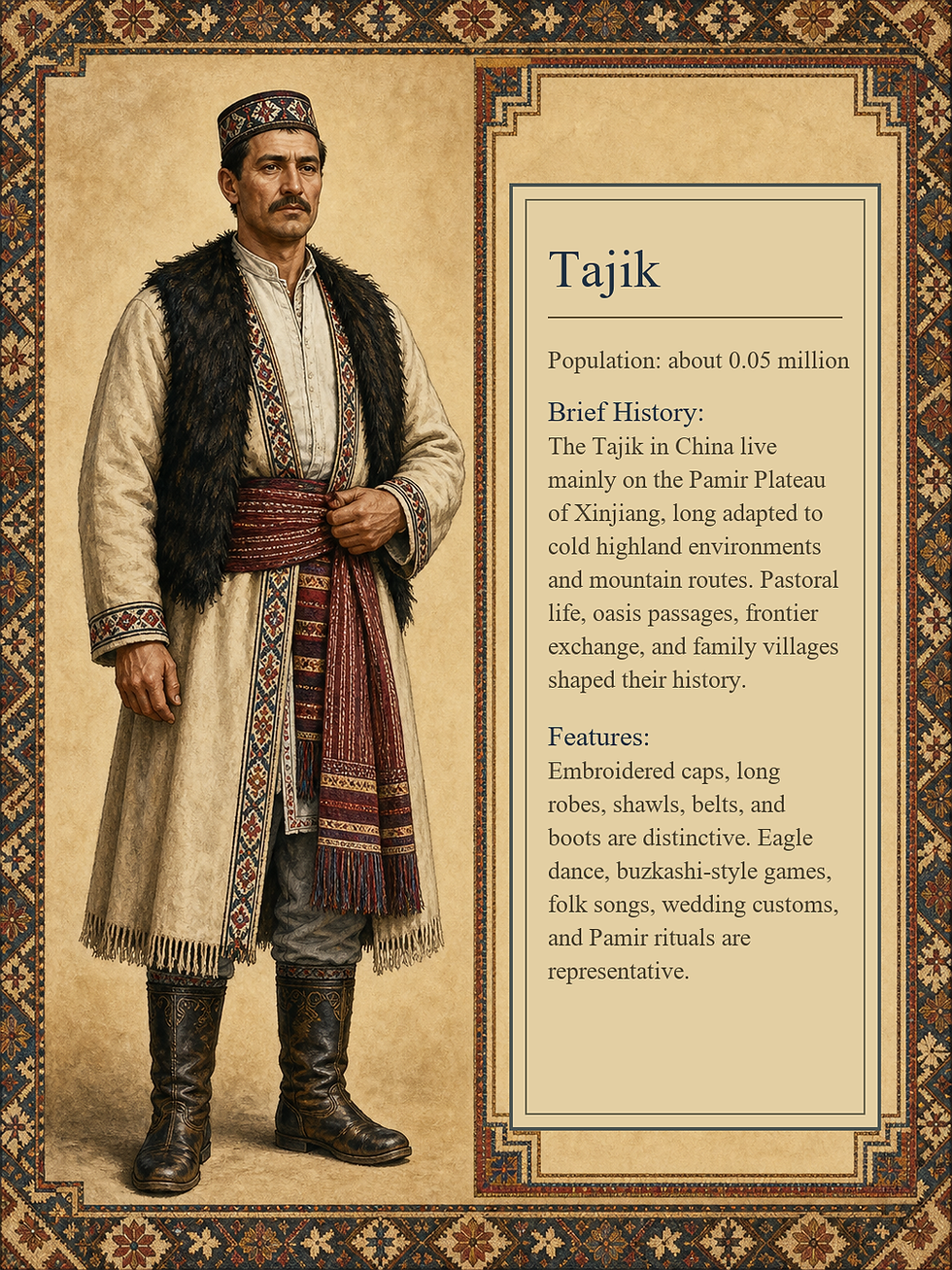
The Tajik ethnic group of China are the only indigenous Caucasian people living within the country's borders, a proud community of roughly fifty thousand who have herded sheep and guarded the western frontier on the Pamir Plateau—the "roof of the world"—since before the tenth century BC. Most call Tashkurgan Tajik Autonomous County in Xinjiang home, a land that borders Pakistan, Afghanistan and Tajikistan in a single glance. The word "Tajik" itself descends from the Persian for "crown," and every embroidered cap and black velvet hat the men wear still carries that regal meaning. If you have only ever experienced China through its megacities and marble museum halls, meeting the Tajik will recalibrate everything you think you know about this country. But the Tajik are far from the only doorway into that deeper China.Across the nation, dozens of ethnic minority cultures still live their traditions as daily reality rather than museum display, and a growing wave of travelers has learned to seek them out. This is the heart of what the travel community increasingly calls Human-designed Travel—itineraries built around genuine cultural exchange and unhurried immersion, rather than tick-box sightseeing. The philosophy is simple: instead of racing between landmarks, you let the rhythm of a place and its people set the pace. For anyone planning such a journey, this leaderboard ranks the ethnic minority experiences that reward your time most generously, drawing on the latest visitor statistics, UNESCO designations and the first-hand field notes of guides who live on the road. The list opens in Xinjiang, then turns south to the region that arguably does ethnic immersion better than anywhere on earth: Yunnan. Read on to plan a journey that leaves you with stories you could never have found online.
1. Tashkurgan, Xinjiang — Meet the Tajik Ethnic Group in Their High-Altitude Homeland
No understanding of the Tajik ethnic group is complete without standing where they stand. Tashkurgan Tajik Autonomous County stretches across 25,000 square kilometers of the eastern Pamir, where four great mountain ranges—the Kunlun, the Karakoram, the Hindu Kush and the Sarykol range—converge like the ribs of the world. The county seat sits at about 3,200 meters above sea level, and nearly everything in view rises higher still, including Muztagh Ata, the "Father of Ice Mountains," and K2, the second-highest peak on earth. The Tajik, who make up over eighty percent of the county's residents, have thrived here through a blend of high-altitude stockbreeding and hardy farming, and their famous hospitality means a cup of milky tea is rarely far away. Do not be surprised if a family waves you in for a meal within your first afternoon in town.What makes this corner of China extraordinary is how intact its culture remains. The Tajik celebrate festivals that most outsiders have never heard of, including three-day weddings where flour is thrown over the groom's shoulders as a symbol of purity, and the springtime Chon Bahar festival that welcomes the new year with singing on the ridgelines. The eagle dance and the eagle flute—the eagle being their most sacred symbol—are national-level intangible cultural heritage, and you can still watch elders perform them at local gatherings. The Tajik observe the festivals of Islam as well, including Ramadan, the Festival of Sacrifice and a distinctive candle-lighting celebration that fills homes with warm light at dusk. Local residents also keep the "one family, one guard post" tradition of frontier defense, a quiet act of patriotism that defines the character of the whole county.For the traveler, the practical draw is equally compelling. The 314 National Highway runs straight through the county, and the Khunjerab Pass crossing into Pakistan sits within reach, as does the Karasu border crossing with Tajikistan. The region is a core staging point for Pamir self-drive journeys, and the newly opened Pamir airport makes access easier than it has ever been. Between the Stone City ruins of the ancient Puli Kingdom, the wetland meadows of Alar Grassland and the winding Panlong Ancient Road, there is enough wilderness and history to fill a full week. You can photograph mirror-still lakes beneath glaciers, watch shepherds move flocks across high pastures, and end each day with steaming bowls of locally raised mutton. The county holds 36 items of national, regional and prefecture-level intangible cultural heritage, as well as 485 immovable cultural relics, so history is never far away.Because the region sits at the meeting point of China, Pakistan, Afghanistan and Tajikistan, the market towns carry a distinctly frontier character. Traders gather at the China–Pakistan border market, and visitors can walk through the bazaar where wool, dried apricots, Tibetan-style jewellery and hand-woven cloth change hands. The altitude and thin air mean it is wise to acclimatize for a day or two before pushing higher, and most sensible itineraries build in time to simply sit, drink tea and talk. That unhurried pace is exactly what makes the place work: the moment you stop rushing, the Tajik open up, sharing songs, stories and photographs of mountain weddings. Whether you come for the glacier views of Muztagh Ata, the border-crossing drama of Khunjerab or simply the warmth of the people themselves, Tashkurgan rewards a flexible schedule. The reward is a rare chance to meet the Tajik ethnic group on their own terms, in a landscape that genuinely feels like the top of the world, far from the beaten tourist track.
2. Lijiang and Shaxi, Yunnan — The Naxi People and the Last Living Tea-Horse Road Market
The ranking now swings south to Yunnan, where ethnic immersion reaches a level of refinement that is difficult to match anywhere in Asia. Start with the Naxi, one of China's most culturally rich peoples, whose Dongba pictographic writing is among the last living hieroglyphic scripts on the planet. In 2025 the Lijiang Old Town alone received 24.18 million visits, a 9.02 percent rise over the previous year, and during the 2026 Spring Festival holiday it welcomed 2.38 million guests in a single stretch, ranking first among all of Yunnan's scenic areas with a one-day peak of 346,400 visitors. Those are imposing numbers, but the magic of Lijiang is that the depth of culture has kept pace with the crowds: more than thirty cultural courtyards now run daily Dongba script classes, Naxi ancient-music concerts and caravan storytelling, so a visitor can go from crowded lanes to an intimate calligraphy lesson in a matter of minutes. Since 2019 the old town has been deliberately thinning out low-end shops, and today some seven hundred cafés spread across the Dayan, Shuhe and Baisha districts, creating a calm, contemplative atmosphere that suits slow travelers.For the traveler who wants to go deeper still, the real treasure lies a short drive away in Shaxi Ancient Town, in Jianchuan County. Known as the only surviving market town of the ancient Tea-Horse Road, Shaxi preserves its Ming- and Qing-dynasty stage, the Xingjiao Temple and the Ouyang Courtyard within living streets. Between January and October 2025, Shaxi received 2.24 million visitors and generated 3.68 billion yuan in tourism revenue, a remarkable figure for a town that has deliberately avoided mass-market overdevelopment. The Naxi and Bai people who live here still trade vegetables in the morning market and welcome guests into centuries-old timber houses. As one local conservationist put it, "A living town is a shared memory; the stage, the temple and the courtyard are just its bones." For a traveler, Shaxi is the kind of place where a single slow afternoon—watching a Bai woman dye indigo cloth, eating locally grown rice, hearing the old stage come alive—feels like a week of ordinary tourism.The wider Jianchuan area adds still more layers. The Bai people, one of China's most artistically accomplished minorities, are famous for their three-course tea ceremony, tie-dye textiles and elaborate mountain-and-cloud embroidery, and several Bai courtyards in the villages around Shaxi open their doors to visitors who wish to try their hand. The region also sits within the larger Dali Prefecture, home to Erhai Lake and the Cangshan mountains, so a Naxi and Bai cultural itinerary can be stitched together across a few unhurried days. Because most tour groups rush through on a single day trip, the traveler who stays overnight in Shaxi finds the town transformed after dusk, when the lanterns come on, the market stalls close and the timber houses glow with warm domestic light. This is Human-designed Travel at its most honest, and it rewards those who linger.
3. Shangri-La and Diqing, Yunnan — Tibetan Culture Without the Crowds
Continue south and west into Diqing Tibetan Autonomous Prefecture, the high country crowned by the old town of Shangri-La. Since the Lijiang–Shangri-La railway opened in 2023, Kunming to Shangri-La now takes just four and a half hours by high-speed rail, and the effect on access has been profound. In 2025 Diqing welcomed 36.36 million domestic and international visitors and generated 29.63 billion yuan in tourism spending, up 16.43 percent and 23.39 percent respectively—both growth rates the fastest in the entire province. What is more telling than the headline numbers is how visitors are staying longer, shifting from quick check-ins to genuine "settled travel," a pattern that mirrors the wider rise of slow, culture-led itineraries across the plateau.The cultural texture here is extraordinary. In the old town of Dukezong, Tibetan, Naxi, Lisu and other communities gather every evening for song and dance that visitors are welcomed to join, and the Songzanlin Monastery—sometimes called the little Potala—weaves a thread of living Buddhism through the landscape. Local artisans still shape black earthenware in Nixi village, press Dongba paper and burn incense in workshops arranged around the Shangri-La airport, and melt yak-butter into modern coffee drinks in tiny lakeside cafés by the Napahai wetland. Local guides weave the story of the 1936 meeting between the Red Army and the monks of Songzanlin into their tours, showing how the region's communities have long been bound together. A young barista from Guangdong who stayed to open a café near the wetlands put it simply: "Every day I look at the snow mountains and invent new drinks with colleagues from many ethnic groups. It gives me a sense of belonging I never found in the city." Few experiences in China feel as far from ordinary tourism as a slow Diqing itinerary built around black pottery, mountain views and cross-cultural coffee.The landscape adds a dramatic backdrop to every cultural stop. Beyond the old town rise the snow peaks of the Kawagebo range, and in winter the revived ski fields of Shika Snow Mountain draw a younger crowd looking for sunshine and powder. The Napahai wetland is a protected international reserve where herons and cranes winter among the reeds, and the roads around it have become a favorite loop for cyclists and photographers. Because the region now markets itself around a "settled travel plus snow and intangible heritage" model, there are farm stays where guests can join a Tibetan family for butter tea and tsampa, and small workshops where you can try your hand at black pottery under the eye of a Nixi master. The evening square dances in Dukezong are famously welcoming, and a growing number of visitors join in each night, clapping and turning in a circle with locals of every age. All of it is reachable in a compact, mountainous area that rewards a few extra days. Few experiences in China feel as far from ordinary tourism, and it is all the richer for the short train ride that makes it possible.
4. Yuanyang, Yunnan — The Hani People and Their 1,300-Year-Old Living Terraces
No ranking of China's ethnic minority experiences would be complete without the Hani of Yuanyang, in Honghe Prefecture, whose rice terraces are one of the most moving landscapes on earth. The Cultural Landscape of the Honghe Hani Rice Terraces was inscribed as a UNESCO World Heritage Site in 2013, and in 2025 the terraces added yet another honor, becoming the world's first "triple heritage" agricultural wonder—World Cultural Heritage, Globally Important Agricultural Heritage and a World Heritage Irrigation Structure all in one. For more than 1,300 years, the Hani have carved these terraces into the steep slopes of the Ailao Mountains, sustaining a symbiotic system of forests, villages, terraces and waterways that still functions exactly as it did a millennium ago. The Hani themselves make up more than half of Yuanyang County's roughly 380,000 residents, and their distinctive mushroom-shaped earthen houses still dot the hillsides.The scale is staggering. The terraces irrigate about 56,100 mu of farmland and cascade from mountaintops to river valleys through thousands of layers, and photographers argue endlessly over whether Duoyishu is best at sunrise, Laohuzui at its most dramatic, or Bada as the clouds roll in at dusk. Yet what lingers longest is not the vista but the people. In Azheke Village, a preserved Hani settlement of earthen mushroom houses, visitors can learn traditional weaving, taste bamboo-steamed dishes and hear the ancient polyphonic songs that are recognized as intangible cultural heritage. Hani women still wear their brilliant silver-laden costumes for festivals, and the harvest rituals are performed with genuine devotion. Around 305 channels, known collectively as "563 veins" in the farmers' language, ferry water from the forested summits to every terrace, a system so elegant that UNESCO praised it as a model of human-environment interaction.For the culturally curious traveler, Yuanyang offers far more than a photograph. The Hani follow a calendar of festivals tied to the planting and harvest cycle, from the Angmatu New Year to the harvest rites of Kuzhazha, and visiting families in the terrace villages reveals a way of life built around red rice, paddy fish and duck eggs. Local cooperatives run farm stays and craft workshops where guests help with weaving, dyeing scarves in indigo or cooking over an open fire, and the region has worked hard to keep tourism respectful and low-impact, with composting, valley-floor parking and careful crowd management. Sunrise at Duoyishu is worth waking before dawn for, but the real reward is sitting in a mushroom-house courtyard afterward, watching a Hani woman shape red rice into a meal while her children run between the terraces. The best time to visit runs from winter through early spring, when the terraces are freshly flooded and catch the light like mirrors, and again in autumn when the ripening rice turns the slopes gold. For a traveler, Yuanyang offers the rare combination of world-class scenery and a culture that is not performing for tourists but simply living. It is a strong candidate for the single most rewarding ethnic immersion in China.
5. The Wider Ethnic Mosaic: From Menglian's Dai Weavers to the Lessons of Human-Designed Travel
The Tajik ethnic group and Yunnan's cultures are the highlights, but the deeper truth is that China's ethnic mosaic rewards patience everywhere. Head to Menglian, on the border with Myanmar, where the 700-year-old Naiyun Ancient Town has quietly become a model of living heritage. Here the Dai people's brocade weaving is not a museum relic but a daily craft, and the provincial-level inheritor Anmeng has transformed ancient patterns into earrings, pendants and toys that now sell across China. In the first four months of 2026, Menglian County received 1.27 million visitors and 1.06 billion yuan in tourism spending, and the town has built three intangible-heritage workshops and five experience points into a complete "display, experience and sales" chain. The message is clear: when a culture is allowed to evolve rather than being frozen, it becomes more alive, not less. This is the same lesson that applies in Guizhou's Miao villages, where silverwork and batik thrive, and in Guangxi's Zhuang country, where rice culture runs deep.This is precisely the philosophy behind Human-designed Travel, and it explains why the experiences in this ranking consistently outperform the alternatives. Research consistently shows that travelers who engage with local craft, food and language report far higher satisfaction than those who simply collect famous sights. In the words of one veteran China travel designer based in Kunming, "The difference between a tour and a journey is whether you leave with stories you could not have read online. When you sit with a Hani woman at her loom, or share flour-covered laughter at a Tajik wedding, you carry that person home with you." Across the 56 ethnic groups of China—from the Uyghurs of Kashgar to the Miao of Guizhou and the Zhuang of Guangxi—there is no shortage of such moments. The trick is simply to slow down, to let a good guide open the right doors, and to choose experiences that respect both the visitor and the community being visited.As the numbers in this guide suggest, the demand for this kind of travel is growing quickly. In Yunnan alone, culture-focused itineraries are seeing double-digit growth, and the province now positions itself explicitly around immersive, no-shopping, small-group experiences that favor genuine exchange over forced stops. For the traveler, the practical implication is that the window to experience these places before they change is wide open, and the smartest itineraries are those planned around cultural rhythm rather than packed schedules. Whether you begin with the eagle dancers of Tashkurgan or the terraced dawn of Yuanyang, the invitation is the same: meet China's ethnic minority peoples not as a spectator but as a guest. Bring curiosity, leave your schedule loose, and let the people you meet set the pace. That, in the end, is what Human-designed Travel is really for, and it is why the Tajik ethnic group, and the extraordinary cultures of Yunnan that follow in their footsteps, deserve a place on your map.


Comments