The Dulong People of Yunnan: Inside China's Most Isolated Ethnic Minority

Introduction
The Dulong people are a unique ethnic minority of roughly 7,000 residents living in Dulong Valley (Dulongjiang) in Gongshan County, Nujiang Lisu Autonomous Prefecture, in the far northwest of Yunnan, China. For centuries, the Dulong were among the most isolated communities on earth, cut off from the outside world by the towering Gaoligong Mountains until the Dulongjiang Highway and its landmark tunnel opened around 2014.
Today, the Dulong people are famous internationally for their elderly 'tattooed women' (纹面女) with elaborate face tattoos, their intricate woven Dulong blankets (独龙毯), their animist traditions, and the annual Kaquewa Festival (卡雀哇节). As Yunnan welcomes record numbers of international travelers in 2026 under the 'China Cool' phenomenon, the Dulong people have become one of the most sought-after, culturally immersive destinations for travelers who want to go beyond the well-trodden paths of Dali and Lijiang.
Based on our years operating cultural trips across Yunnan, we have watched interest in Dulong Valley grow steadily. If you are planning a deep-culture Yunnan itinerary, here is everything you need to understand about the Dulong people before you go.
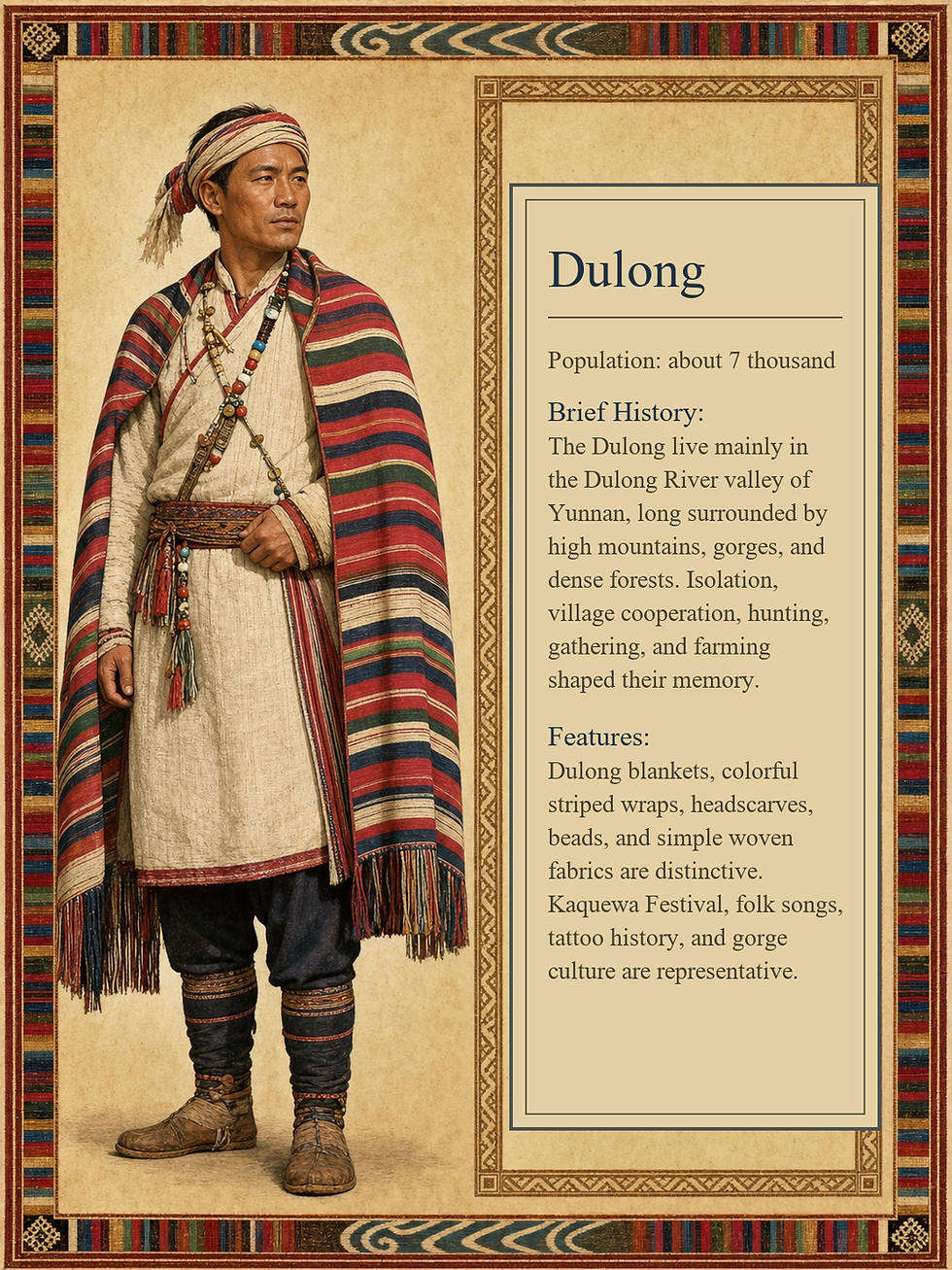
Who Are the Dulong People?
The Dulong people are one of the 55 officially recognized ethnic minorities in China and among the least populous, with a population of about 7,000. They live almost exclusively in the Dulong River valley, which forms the westernmost inhabited region of China, sharing a border with Myanmar's Kachin State. For generations, the Dulong lived in near-total isolation, practicing slash-and-burn agriculture, hunting with crossbows, and trading through simple barter systems.
The name 'Dulong' comes from the Dulong River (独龙江), around which their civilization developed. Culturally, they are closely related to the Nu people and other groups of the Nujiang Grand Canyon corridor, though they developed a distinct language, customs, and identity. Statistics from China's national census put the Dulong population at just over 7,000 people, making them one of the smallest ethnic groups in the country.
Despite their small numbers, the Dulong people have captured global imagination. Anthropologists and documentary filmmakers have long been drawn to their story of resilience and cultural survival in one of the most challenging landscapes on Earth. Their journey from an isolated tribal society to a connected, modernizing community within a single generation is one of the most remarkable cultural transitions documented in 20th and 21st century China.
Where Is Dulong Valley?
Dulong Valley, or Dulongjiang, is located in the far northwest of Yunnan Province, in Gongshan Dulong and Nu Autonomous County (贡山独龙族怒族自治县). The valley runs along the Dulong River and is wedged between the Gaoligong Mountains to the east and the Myanmar border to the west. This region is part of the larger Nujiang Grand Canyon area, one of the most dramatic and biologically rich landscapes in Asia.
The Gaoligong Mountains, through which the road to Dulong Valley passes, are recognized as a globally significant biodiversity hotspot. The area has been associated with UNESCO World Heritage designations for its exceptional ecological value, harboring thousands of plant species and numerous endemic animals. Travelers who make the journey are rewarded with pristine primary forest, waterfalls, and some of the most remote mountain scenery in China.
Geographically, Dulong Valley sits at the very edge of China's Yunnan province, close to the border with Myanmar. This frontier location has historically shaped Dulong life: the isolation of the valley meant that until the 1950s, contact with the outside world was minimal, and traditional Dulong customs survived well into the modern era. Today, reaching the valley requires a journey through the Gaoligong Mountains via the Dulongjiang Highway, which we will cover in detail in our travel planning guide.
The Famous 'Tattooed Women' Tradition
Perhaps the most iconic image associated with the Dulong people is that of the 'tattooed women' (纹面女), elderly Dulong women whose faces are covered in intricate blue-black tattoos. The practice, which involved using a bamboo stick to prick the skin and rubbing soot into the wounds, was historically applied to women when they reached adolescence or adulthood.
The origins of the facial tattooing tradition are debated. One theory holds that the tattoos were meant to protect women from being captured by raiders from neighboring regions; another suggests they were considered a mark of beauty and adulthood within Dulong society; still others believe the tattoos had spiritual or protective significance in the animist worldview of the Dulong people. Anthropologists continue to study the practice, but it is widely agreed that the tattoos held deep cultural meaning.
The practice of facial tattooing was banned or discouraged in the mid-20th century, and the custom has now essentially died out among younger generations. Today, the surviving tattooed women are elderly grandmothers, and their numbers dwindle each year. This has made meeting them one of the most poignant and sought-after cultural experiences in Yunnan. In our dedicated article on the tattooed women tradition, we explore the history, the ethics of visiting, and how to respectfully document their stories before they are gone.
Dulong Culture Today: Language, Weaving, and Animism
The Dulong language, part of the Tibeto-Burman family, was historically an oral language with no written form. In recent decades, linguists and local authorities have worked to develop a written script for Dulong, and language preservation efforts continue alongside a push for younger generations to learn both Mandarin and their ancestral tongue. For travelers, even learning a few Dulong words of greeting is warmly appreciated.
The Dulong blanket (独龙毯), also sometimes called a 'Dulong rainbow blanket' for its bold striped patterns, is the signature craft of the Dulong people. Traditionally woven from hemp or hand-spun wool dyed with natural plant colors, the blankets are both practical rain protection (they are water-resistant) and powerful symbols of Dulong identity. Today, Dulong blankets are highly prized cultural artifacts, and several weaving cooperatives in the valley allow visitors to watch artisans at work and purchase authentic pieces directly from the community.
Dulong spirituality is animist and shamanic, centered on a belief in spirits inhabiting the natural world. Historically, shamans (the Dulong term is 'nampa') played central roles in healing, ceremonies, and community guidance. While many Dulong people today follow a blend of traditional beliefs and other faiths, animist traditions remain a living part of village life, particularly during festivals and rites of passage. The Kaquewa Festival, held around the New Year period, is the most important celebration in the Dulong calendar, featuring feasting, dancing, sacrifices, and communal rituals that offer travelers a rare window into Dulong cultural life.
How to Visit Dulong Valley Responsibly
Visiting the Dulong people is a privilege that comes with significant responsibility. The community has only recently opened to tourism, and its residents are navigating how to share their culture while protecting their way of life. Travelers should approach with humility, respect, and a genuine desire to learn rather than merely observe.
The first rule of responsible cultural tourism in Dulong Valley is to always ask before photographing people, especially the elderly tattooed women. Many elders are comfortable being photographed by prior arrangement through a guide, but consent is non-negotiable, and it is customary to show appreciation (often a small contribution or purchase of local crafts). Always follow the guidance of local hosts and licensed guides who have established relationships with the community.
Second, travelers should prioritize community benefits. Buying authentic Dulong blankets directly from weaving cooperatives, hiring local guides, staying in community-run homestays, and participating in culturally respectful experiences all ensure that tourism revenue flows back to the Dulong people. This aligns with the growing global movement toward community-based tourism and the 'China Cool' emphasis on immersive, mutually beneficial cultural exchange. As Yunnan's inbound tourism surged over 20% in 2026, responsible, respectful travel is more important than ever to ensure the Dulong people benefit from their newfound global visibility.
Frequently Asked Questions About the Dulong People
Q: How many Dulong people are there?
A: There are approximately 7,000 Dulong people, making them one of the smallest officially recognized ethnic minorities in China. They live mainly in Dulong Valley in Gongshan County, northwest Yunnan.
Q: Where do the Dulong people live?
A: The Dulong people live in Dulong Valley (Dulongjiang) in Gongshan Dulong and Nu Autonomous County, Nujiang Prefecture, in the far northwest of Yunnan, near the Myanmar border.
Q: What is the tattooed women tradition?
A: The 'tattooed women' (纹面女) tradition involved Dulong women receiving facial tattoos as a rite of passage. The practice was largely discontinued in the mid-20th century, and today only elderly women still bear the tattoos.
Q: What is the Kaquewa Festival?
A: The Kaquewa Festival (卡雀哇节) is the most important annual celebration for the Dulong people, marking the New Year with feasting, dancing, sacrifices, and community rituals.
Q: What is a Dulong blanket?
A: A Dulong blanket (独龙毯) is a distinctive woven textile with bold striped patterns, historically used as waterproof rain protection and now a signature cultural craft.
Q: Is Dulong Valley safe to visit?
A: Yes, Dulong Valley is safe for visitors, but travel requires planning due to its remote location, mountainous terrain, and changing road conditions. Traveling with an experienced Yunnan guide is strongly recommended.
Q: When is the best time to visit Dulong Valley?
A: The best time is generally from October to April, when the weather is drier. The rainy season (May to September) can bring landslides and road closures in the Gaoligong Mountains.
How to Travel to Dulong Valley, Yunnan: The Road Through the Gaoligong Mountains
Meta Description: Plan your trip to Dulong Valley, Yunnan. Learn about the Dulongjiang Highway, the tunnel through the Gaoligong Mountains, routes from Lijiang, Dali, and Kunming, the best seasons, and a sample Nujiang Grand Canyon itinerary for 2026.
Introduction
Getting to Dulong Valley is an adventure in itself. The journey begins in Kunming, Yunnan's capital, and winds west through Dali and Lijiang to Gongshan County, then threads through the Gaoligong Mountains via the Dulongjiang Highway and its landmark tunnel, which opened around 2014 to connect the valley to the outside world year-round.
Because of the valley's extreme isolation and mountainous terrain, planning is essential. The Dulongjiang Highway is an engineering marvel and the only road access, and seasonal weather can close the pass. In this guide, we share the routes, seasons, permits, and practical details you need to travel to Dulong Valley safely and enjoyably, drawing on our first-hand experience leading cultural journeys through the Nujiang Grand Canyon.
The Dulongjiang Highway: A Landmark Road
For most of recorded history, the Dulong people had no road. Access to Dulong Valley was a multi-day trek over the Gaoligong Mountains, often impassable for months during heavy snow and rain. The construction of the Dulongjiang Highway changed everything. Completed in stages with the crucial Gaoligong Tunnel opening around 2014, the highway finally connected the Dulong people to the rest of Yunnan on a year-round basis.
The highway is a remarkable feat of engineering, carving through some of the most rugged and ecologically sensitive terrain in China. It passes through the Gaoligong Mountains, an area so biodiverse it is associated with UNESCO World Heritage designations, and the drive offers stunning views of primary forest, steep gorges, and the Dulong River far below. Weather permitting, the road is navigable by regular vehicles, though conditions can be challenging and schedules can shift with the seasons.
For travelers, the highway is more than infrastructure; it is the story of a people emerging from isolation. According to 2026 travel industry data, cultural destinations in Yunnan are surging in popularity, with inbound visitors to the province growing over 20% year-on-year. The road to Dulong Valley is now at the heart of that trend, enabling the community to share its heritage while welcoming visitors who previously could not reach it.
Getting to Gongshan County from Lijiang, Dali, and Kunming
Dulong Valley is reached through Gongshan County (贡山县), the administrative center of the area. Gongshan itself is remote, and most travelers approach it from one of Yunnan's better-known hubs: Kunming, Dali, or Lijiang.
From Kunming, the provincial capital, the drive to Gongshan takes roughly two full days, with an overnight stop along the way. The most common route follows the expressways west through Dali and then the Nujiang (Salween) River valley northward. From Dali, the journey into the Nujiang Grand Canyon is a spectacular drive through dramatic gorges and Lisu and Nu villages. From Lijiang, a popular gateway for international travelers, the route heads north and west, also connecting through the Nujiang corridor.
Public transport exists but is limited and slow; buses and shared vans connect the main towns, but schedules are sparse. For most travelers, especially those on a fixed itinerary, a private guided transfer is the practical choice. This is where an experienced Yunnan operator makes a real difference. With our local drivers and knowledge of road conditions, we handle the logistics so you can focus on the journey. As a general rule, budget at least four to five days round-trip from Lijiang or Dali if you want to spend meaningful time in the valley itself.
Crossing the Gaoligong Mountains
The Gaoligong Mountains are the natural barrier that has shaped Dulong life for centuries. The mountain range, running north-south along the border with Myanmar, reaches elevations well over 4,000 meters and contains one of the most species-rich temperate forest ecosystems on Earth. Its ecological importance is so great that the region is linked to UNESCO World Heritage listings and is a priority area for conservation.
Crossing the range to reach Dulong Valley means traversing the Dulongjiang Highway and passing through the tunnel that pierces the mountains. The journey is scenic but demanding: winding roads, steep gradients, and sudden weather changes are common. Travelers should be prepared for a full day of driving from Gongshan town to the heart of the valley, with stops for photographs, local meals, and to admire the extraordinary scenery.
The biodiversity of the Gaoligong Mountains is staggering. Botanists have documented thousands of plant species, including rare orchids, rhododendrons, and ancient tree species, alongside a rich fauna of birds, primates, and large mammals. For nature lovers, the drive is a highlight in itself. Conservation is a growing concern as tourism increases, and responsible travelers should stay on designated routes, avoid disturbing wildlife, and support local conservation efforts.
Best Seasons to Visit Dulong Valley
Timing your visit to Dulong Valley is crucial. The valley has two main seasons: a rainy, cloudy season from roughly May to September, and a drier, clearer season from October to April.
The rainy season brings lush green landscapes but also significant risk. Heavy rain in the Gaoligong Mountains can trigger landslides, rockfalls, and temporary road closures, sometimes cutting the valley off for days. If you travel in the rainy season, allow generous buffer time and remain flexible. The dry season, especially October through April, offers more reliable road access, clearer mountain views, and more comfortable trekking conditions, though winter can bring cold temperatures and occasional snow at higher elevations.
For cultural experiences, the timing can also matter. The Kaquewa Festival, the Dulong New Year celebration, is a highlight that draws those who want to witness Dulong rituals and community life. Its exact date follows the traditional lunar calendar and varies by year and village, so check current schedules or travel with a guide who can help you align your visit. Regardless of season, always confirm road conditions before setting out, as mountain weather is unpredictable even in the 'good' season.
Sample Itinerary: 7 Days in the Nujiang Grand Canyon
A well-rounded cultural journey to Dulong Valley is best framed within the broader Nujiang Grand Canyon region. Here is a sample 7-day itinerary that balances travel time with rewarding experiences, designed from our own guiding experience:
Day 1: Arrive in Dali or Lijiang and transfer toward the Nujiang corridor, overnighting in a town along the Salween River. Day 2: Drive north through the Nujiang Grand Canyon, visiting Lisu and Nu villages, and reach Gongshan County. Day 3: Cross the Gaoligong Mountains via the Dulongjiang Highway and arrive in Dulong Valley; settle into a community-run homestay. Day 4: Explore Dulong Valley, meet local families, watch Dulong blanket weaving, and, with a guide's arrangement, meet tattooed women elders who are willing to share their stories. Day 5: Hike in the surrounding valleys and forests, learning about animist traditions and the natural world. Day 6: Return across the mountains to Gongshan or continue south along the Nujiang corridor. Day 7: Drive back to Lijiang or Dali, or extend your journey to other Yunnan highlights.
This is just one template; itineraries can be shortened or extended, and the exact route depends on your interests, fitness level, and the season. What remains consistent is that Dulong Valley rewards those who take the time. As travel data from 2026 shows, deeper, slower, culturally immersive journeys are exactly what increasingly discerning travelers to Yunnan are seeking.
Frequently Asked Questions About Traveling to Dulong Valley
Q: How long does it take to reach Dulong Valley from Lijiang?
A: The full journey from Lijiang to Dulong Valley typically takes about two days of driving, with an overnight stop in the Nujiang corridor. Budget at least 4-5 days round-trip to spend meaningful time in the valley.
Q: Do I need a permit to visit Dulong Valley?
A: Dulong Valley is within a border region of China near Myanmar. Travel rules can change, and arrangements may be needed for foreigners. Confirm current requirements with your Yunnan travel operator before you go.
Q: Is the Dulongjiang Highway safe?
A: The highway is generally safe in good weather, but it is a mountainous road with steep gradients and can be affected by landslides during the rainy season. Travel with an experienced driver and flexible schedule.
Q: What is the best time of year to visit?
A: October to April offers the most reliable road access and clearer views. The rainy season (May-September) brings landslide risk and possible road closures.
Q: Can I visit Dulong Valley independently?
A: It is possible but challenging due to limited public transport, road conditions, and remote logistics. Most travelers use a guided tour or private driver for safety and to arrange cultural experiences.
Q: Where should I stay in Dulong Valley?
A: Community-run homestays in Dulong villages offer the most authentic and beneficial experience, ensuring your stay directly supports the local people.
Dulong Culture Deep-Dive: Tattooed Women, the Kaquewa Festival & a Kiki Holidays Custom Tour
Meta Description: Experience Dulong culture up close with Kiki Holidays (Kunming Yongrun). Meet the tattooed women, attend the Kaquewa Festival, learn Dulong blanket weaving, and enjoy a small-group, no-shopping cultural tour designed by Yunnan local experts.
Introduction
For travelers who want more than a glimpse, a Kiki Holidays Dulong Valley cultural tour offers an immersive, respectful, and deeply rewarding way to meet the Dulong people. Our small-group, no-shopping itineraries are designed by Yunnan local experts who have built trusted relationships with Dulong families over years of operating in the region.
From sitting with the last tattooed women to watching the Kaquewa Festival's rituals and learning the art of Dulong blanket weaving from village artisans, our custom tours are built around genuine cultural exchange. Here is what a deep-dive Dulong experience looks like with Kiki Holidays, and why responsible, community-focused travel is the heart of everything we do.
Meeting the Last Tattooed Women
One of the most moving experiences in Dulong Valley is meeting the tattooed women (纹面女), the elderly grandmothers whose faces carry the fading tradition of facial tattoos. Their stories are living history, connecting today's travelers to a way of life that has all but disappeared.
Through Kiki Holidays, visits are arranged respectfully and in advance through local community contacts, always with the women's full consent. We follow strict ethical guidelines: photography only when welcomed, modest gestures of appreciation, and a genuine conversation rather than a spectacle. These elders are not exhibits; they are honored community members whose memories are invaluable.
Meeting them is a privilege that leaves a lasting impression. Travelers often describe it as the highlight of their entire Yunnan journey. As the number of tattooed women declines each year, these encounters have also become a race against time, making respectful documentation and cultural preservation all the more urgent. Our guides ensure the experience honors the women's dignity while letting travelers connect meaningfully.
The Kaquewa Festival: Date, Rituals, and How to Attend
The Kaquewa Festival (卡雀哇节) is the most important celebration in the Dulong calendar, marking the arrival of the New Year. It is a time of thanksgiving, feasting, and renewal, when the community gathers to perform rituals, share food, and reinforce bonds.
The festival typically includes sacrificial offerings, traditional dances, communal meals, and exchanges of goodwill. The exact date follows the lunar calendar and can vary between villages and years, so attending requires flexible planning. For travelers, participating in the Kaquewa Festival is a rare and profound opportunity to witness Dulong spiritual life and community spirit firsthand.
Kiki Holidays can help arrange attendance when the festival falls within your travel dates, coordinating with village organizers so you join as a respectful guest rather than an intrusive observer. Because the festival draws the community together, it is also a chance to support local food producers, artisans, and families. Travel data for 2026 shows festivals and living-culture events are among the fastest-growing draws for cultural travelers to Yunnan, and the Kaquewa Festival is a standout example.
Learning Dulong Blanket Weaving from Local Artisans
The Dulong blanket (独龙毯) is more than a textile; it is a symbol of Dulong identity, woven with patterns that carry meaning passed down through generations. Traditionally made from hemp or hand-spun wool and dyed with natural plant pigments, the blankets are celebrated for their bold, rainbow-like stripes and practical durability.
In Dulong Valley, several weaving cooperatives and family workshops welcome visitors to watch artisans at work and even try their hand at the loom. These experiences go beyond souvenir shopping: they are live demonstrations of a craft central to Dulong culture, and they put money directly into the hands of local women and their families.
For Kiki Holidays, supporting these cooperatives is a core part of our community-benefit philosophy. When you purchase an authentic Dulong blanket, you are investing in cultural preservation and economic empowerment. In an era when travelers increasingly seek meaningful, ethical purchases, the Dulong blanket is a perfect example of a product that tells a story and does good at the same time.
What a Kiki Holidays Dulong Valley Tour Includes
A Kiki Holidays custom Dulong Valley tour is built around your interests, pace, and comfort level, but every journey shares our core commitments: small groups, no forced shopping stops, local expertise, and genuine cultural exchange.
Depending on the itinerary, a tour typically includes: private or small-group transfers with experienced local drivers; comfortable accommodation ranging from community homestays to quality hotels; guided cultural experiences such as meeting tattooed women, visiting weaving cooperatives, and exploring Dulong villages; trekking in the surrounding mountains with knowledgeable local guides; and meals featuring local cuisine. Our guides are Yunnan-based specialists who speak multiple languages and have first-hand relationships with the communities we visit.
Because we are a local Yunnan operator, we can adapt to your schedule, interests, and the realities of mountain travel with flexibility that larger, non-local agencies cannot match. Whether you want a quick 4-day cultural immersion or a broader 10-day Nujiang Grand Canyon expedition, we design it around you. As inbound travel to Yunnan grows rapidly in 2026, having a trusted local partner makes the difference between a good trip and a truly transformative one.
Responsible Tourism: Supporting the Dulong Community
Responsible tourism is not an add-on at Kiki Holidays; it is the foundation. The Dulong community has recently opened to the outside world, and how visitors behave will shape whether tourism becomes a blessing or a burden for the people who call Dulong Valley home.
We operate on principles of consent, respect, and benefit-sharing. This means: always asking before photographing people; following the guidance of village hosts; ensuring tourism revenue reaches local families through homestays, cooperatives, and guides; minimizing environmental impact by staying on trails and managing waste responsibly; and supporting conservation of the fragile Gaoligong Mountains ecosystem.
The 'China Cool' wave has brought more international visitors to Yunnan than ever before, with inbound numbers up over 20% in the first half of 2026. With that growth comes responsibility. By choosing a responsible, community-focused operator and traveling with humility and curiosity, you help ensure the Dulong people thrive, not just survive, in the era of global travel. That is the kind of journey we believe travel should be.
Frequently Asked Questions About Dulong Culture Tours
Q: Can I meet the tattooed women of Dulong Valley?
A: Yes, through prior arrangement with local community contacts. Kiki Holidays arranges respectful visits with the full consent of the elders. Photography is only done when welcomed.
Q: When is the Kaquewa Festival held?
A: The Kaquewa Festival (卡雀哇节) is the Dulong New Year celebration, held according to the traditional lunar calendar. The exact date varies by village and year; check current schedules or travel with a guide.
Q: Can I learn to weave a Dulong blanket?
A: Many weaving cooperatives in Dulong Valley welcome visitors to watch artisans and try weaving. It is a wonderful cultural experience and directly supports local women.
Q: Does Kiki Holidays offer no-shopping tours?
A: Yes. All Kiki Holidays tours are small-group and no-shopping, focused on genuine cultural experiences rather than forced retail stops. This aligns with the best-practice standards in Yunnan tourism.
Q: How do Kiki Holidays tours support the Dulong community?
A: We use community-run homestays, hire local guides, support weaving cooperatives, and follow strict ethical guidelines to ensure tourism revenue benefits local families.
Q: Can you design a custom Dulong Valley itinerary?
A: Absolutely. As a local Yunnan operator, Kiki Holidays designs custom itineraries around your interests, schedule, and fitness level, from short cultural immersions to broader expeditions.
Dulong Tattooed Faces: The Vanishing Tradition of China's Tattooed Women
Meta Description: Explore the mysterious Dulong tattooed women tradition (纹面女). Why did Dulong women tattoo their faces, why has the practice vanished, how many tattooed women remain in 2026, and how to visit ethically.
Introduction
The tattooed women of Dulong Valley, known as 纹面女, are among the most evocative cultural images in all of China. These elderly Dulong grandmothers bear intricate blue-black tattoos across their faces, the legacy of a tradition that has now all but vanished from the modern world.
This article explores why Dulong women tattooed their faces, how the practice arose and ended, how many tattooed women are believed to remain today, and how travelers can respectfully encounter and honor this vanishing piece of living history.
Why Did Dulong Women Tattoo Their Faces?
The origins of facial tattooing among the Dulong people are not fully documented, and multiple explanations have been proposed over the decades. Anthropologists and oral tradition offer several overlapping theories.
One widely cited explanation is that the tattoos were intended to make Dulong women less attractive to raiders or slavers from neighboring groups, who were said to have preyed on the region. By permanently marking their faces, the theory goes, women protected themselves from being captured and taken away.
Another interpretation holds that the tattoos were a mark of beauty, adulthood, and social belonging within Dulong society. In this view, receiving the facial tattoo was a rite of passage that signaled a young woman's transition to adulthood and her place in the community. Still other scholars and elders link the practice to spiritual beliefs, suggesting the tattoos had protective or ritual significance in the Dulong animist worldview. The truth is likely a blend of these factors, and the meaning may have varied across villages and generations.
The History of Face Tattoos in Dulong Society
Facial tattooing was historically a widespread custom among Dulong women, applied when girls reached a certain age, typically around adolescence or early adulthood. The process was painful: a sharp bamboo or thorn was used to prick the skin in patterns across the face, and soot or plant pigment was rubbed into the wounds to leave permanent dark markings.
The designs varied but typically covered much of the face, including the forehead, cheeks, and chin, with patterns that often extended to the nose and around the mouth. The precise patterns differed between villages and families, and they carried personal and cultural meaning for the women who bore them.
The practice began to decline in the mid-20th century as the Chinese government integrated the Dulong region and discouraged the custom, and as younger generations adopted modern aesthetics and values. Within a few decades, the tradition effectively ceased. Today, the tattooed women are elderly, and their distinctive faces represent the last living link to a custom that will soon exist only in photographs, oral histories, and the memories of their descendants.
How Many Tattooed Women Remain Today?
The number of surviving tattooed women has declined steadily, and precise counts are difficult to establish as elders pass away and new generations are born without the tradition. Reports over recent years have consistently described the tattooed women as a dwindling, elderly population, with estimates ranging from a few dozen to under a hundred at any given time.
Documentary projects and cultural preservation efforts have worked to record their stories and portraits, recognizing that this is a finite window. Travelers and researchers who visit Dulong Valley today are witnessing a cultural chapter that will soon close, making these encounters both precious and time-sensitive.
For those who want to understand the current situation accurately, it is best to consult recent cultural and anthropological reporting, and to rely on local guides and community members who know the actual number of living tattooed women and their wishes regarding visitors. Respecting their privacy and consent is paramount, especially as they age.
Ethical Visiting: Photography and Respect Guidelines
Meeting the tattooed women is a profound experience, but it comes with ethical obligations. These are elderly community members, not tourist attractions, and their dignity and wishes must always come first.
The cardinal rule is consent. Always ask before photographing, and accept a refusal gracefully. Many elders are willing to be photographed by prior arrangement through a guide, but this should never be assumed. It is customary to show appreciation, often through a small gesture or by purchasing local crafts, as a respectful acknowledgment of their time and openness.
Avoid turning encounters into a spectacle. Keep groups small, speak softly, and allow time for genuine conversation rather than rushing for the photo. Listen to the stories they choose to share, and let the moment be about connection, not collection. By approaching with humility and respect, you honor the women and the tradition, and you contribute to a form of cultural tourism that the Dulong community can welcome rather than resent.
Preserving the Story for Future Generations
As the tattooed women pass on, preserving their stories becomes a matter of urgency. Documentation projects, oral histories, photographs, and museum collections all play a role in ensuring this tradition is not forgotten.
The Dulong community itself is increasingly engaged in preservation, recognizing the value of its own heritage. Weaving cooperatives, cultural centers, and festivals keep Dulong identity alive, and younger generations are being encouraged to learn their language and crafts. Travelers can support these efforts by purchasing authentic Dulong crafts, visiting community-run cultural sites, and sharing accurate, respectful information.
Ultimately, the story of the tattooed women is not just about the past; it is a reminder of the value of cultural diversity and the importance of treating living cultures with dignity. For the travelers who are privileged to meet them, the tattooed women offer a lesson in resilience, identity, and the human capacity for both change and memory. As Yunnan continues to welcome the world in 2026 and beyond, let us ensure these encounters remain respectful, meaningful, and beneficial to the people who carry this extraordinary heritage.
Frequently Asked Questions About the Tattooed Women
Q: Why did Dulong women tattoo their faces?
A: The reasons are debated and likely multiple: protection from raiders, a mark of beauty and adulthood, and spiritual significance within Dulong animist culture.
Q: Is the Dulong facial tattoo tradition still practiced?
A: No. The practice was discouraged in the mid-20th century and has essentially ceased. Today, only elderly women bear the tattoos, and their numbers are declining.
Q: How many tattooed women are left?
A: The exact number is uncertain and declines each year, with estimates ranging from a few dozen to under a hundred at any given time. Local guides know the current situation best.
Q: Can I take photos of the tattooed women?
A: Only with explicit consent, ideally arranged through a guide. Always ask first, respect refusals, and show appreciation for their time.
Q: Where can I meet the tattooed women?
A: The tattooed women live in Dulong Valley, Gongshan County, northwest Yunnan. Visits are best arranged respectfully through a responsible local guide.
Beyond Dali and Lijiang: Dulong Valley and Yunnan's Hidden Cultural Depth
Meta Description: Go beyond Dali and Lijiang to discover Yunnan's hidden cultural depth in 2026. Explore Dulong Valley, the 'China Cool' trend, the Nujiang Grand Canyon, and why immersive off-the-beaten-path experiences define the new era of Yunnan travel.
Introduction
Yunnan is famous for Dali, Lijiang, and Shangri-La, but in 2026 the most compelling travel story is happening far beyond those well-known gateways. At the heart of the 'China Cool' phenomenon, travelers are venturing deeper into the province, and one of the most extraordinary destinations is Dulong Valley, home to the Dulong people.
This article explores why Yunnan has become the epicenter of immersive cultural travel, why the Nujiang Grand Canyon and Dulong Valley represent the province's hidden depth, and how to experience this remote corner of China responsibly and memorably.
Why Yunnan Is the Epicenter of 'China Cool' in 2026
In 2026, 'China Cool' has become one of the defining narratives in global travel. The term captures a new wave of visitors drawn not to China's big-city skylines but to its cooler climates, rich cultures, and authentic everyday life. Yunnan, with its mild summer temperatures, stunning landscapes, and remarkable ethnic diversity, sits at the center of this trend.
The numbers tell the story. In the first half of 2026, China welcomed 22.91 million inbound foreign visitors, a 20.4% increase year-on-year, according to official immigration data. Yunnan has been a standout beneficiary: inbound bookings to Lijiang grew 1.2 times, arrivals from Vietnam to Lijiang rose 4.5 times, and Kunming's ports processed over 800,000 inbound travelers, up 21%. Data from 2026 also shows that over half of international visitors now stay four days or more in Yunnan, a shift from quick 'check-the-box' stops to genuine immersion.
The appeal is simple: Yunnan offers a perfect blend of cool weather, stunning scenery, vibrant ethnic cultures, and a relaxed pace. From the cafes of Dali to the markets of Lijiang, international travelers are embracing the province's 'slow, immersive' ethos. For those who want to go even deeper, the Nujiang Grand Canyon and Dulong Valley represent the frontier of this journey.
The Nujiang Grand Canyon: A Hidden Cultural Corridor
The Nujiang (Salween) Grand Canyon is one of the most dramatic river valleys on Earth and a hidden treasure of Yunnan. Running north through the province near the Myanmar border, it is home to a remarkable mosaic of ethnic groups, including the Lisu, Nu, Tibetan, and Dulong peoples, each with distinct languages, customs, and ways of life.
Unlike the well-touristed corridors of Dali and Lijiang, the Nujiang canyon remains largely untouched by mass tourism. Travelers who venture here are rewarded with dramatic gorge scenery, swinging bridges, terraced fields, and villages where traditional life continues largely as it has for generations. It is, in many ways, the Yunnan that travelers dream of but rarely find.
The canyon also serves as the gateway to Dulong Valley, connecting visitors to one of the most isolated and culturally intact communities in China. As 'China Cool' travelers increasingly seek authenticity over convenience, the Nujiang Grand Canyon has become a symbol of the deeper, more meaningful journeys that define the new era of travel to Yunnan.
Dulong Valley vs. Other Yunnan Ethnic Villages
Yunnan is home to more officially recognized ethnic minorities than any other province in China, and its ethnic villages range from well-developed tourist destinations to remote communities untouched by visitors. Dulong Valley occupies a unique position on this spectrum.
Compared to the polished, heavily-visited ethnic villages near Dali or Lijiang, Dulong Valley offers a far more authentic and unmediated experience. Here, tourism is still in its early stages, and the Dulong people are actively deciding how to share their culture. Visitors are guests, not audiences, and the exchange is genuine rather than staged.
This authenticity comes with trade-offs. Dulong Valley is remote, requires more planning, and offers fewer comforts than developed tourist hubs. But for travelers seeking the kind of deep cultural connection that 'China Cool' promises, the trade-off is worth it. In a survey context, immersive cultural experiences are increasingly cited as the top reason travelers choose destinations like Yunnan, and Dulong Valley delivers that immersion more powerfully than any developed village.
Self-Guided vs. Guided Approaches to Remote Yunnan
Reaching Dulong Valley can be done independently, but it is not for everyone. The remote location, limited public transport, mountain road conditions, and the need to arrange culturally appropriate experiences all make a guided approach more practical for most travelers.
A guided tour brings distinct advantages: experienced drivers who know the mountain roads, local guides who have relationships with Dulong families and can arrange respectful visits to see the tattooed women or attend the Kaquewa Festival, and flexible logistics that adapt to changing conditions. For a region where consent, cultural sensitivity, and safety matter, a responsible local operator adds enormous value.
That said, independent travel is possible for experienced, well-prepared adventurers who are comfortable with uncertainty. If you go solo, research road conditions carefully, allow generous time, and respect community norms, especially around photography. Whichever approach you choose, the goal is the same: to experience the Dulong people and the Nujiang Grand Canyon with humility, curiosity, and respect.
Combining Dulong Valley with a Wider Yunnan Itinerary
Dulong Valley is best experienced as part of a broader Yunnan journey rather than as a standalone destination. Its remote location means a visit involves significant travel time, so combining it with other highlights creates a richer, more efficient itinerary.
A classic combination pairs Dulong Valley with the Nujiang Grand Canyon, then continues to Lijiang, Shangri-La, and the Tibetan-influenced towns of northwest Yunnan. Travelers can also link south to Dali, the tea mountains of Pu'er, or the tropical landscapes of Xishuangbanna, depending on time and interests. Each region offers a different facet of Yunnan's extraordinary diversity.
When designing a combined itinerary, allow sufficient time in the canyon region, where distances are long and roads can be slow. A typical deep-Yunnan journey of 10 to 14 days can comfortably include Dulong Valley, the Nujiang corridor, Lijiang, and Shangri-La, with stops for cultural experiences and trekking along the way. As more travelers discover Yunnan's hidden depth in 2026, these multi-region itineraries are becoming the new standard for immersive travel to the province.
Frequently Asked Questions About Hidden Yunnan Travel
Q: What is 'China Cool' travel?
A: 'China Cool' is the 2026 travel trend drawing international visitors to China's cooler climates, rich cultures, and authentic everyday life. Yunnan, with its mild summers and ethnic diversity, is a centerpiece of the trend.
Q: Is Dulong Valley worth the journey?
A: For travelers seeking authentic, immersive cultural experiences, absolutely. It is one of the most remote and culturally intact communities in China, offering genuine exchange rather than staged tourism.
Q: How is Dulong Valley different from other Yunnan ethnic villages?
A: Unlike developed tourist villages near Dali or Lijiang, Dulong Valley is still emerging into tourism. Experiences are authentic, community-led, and unmediated, though the journey requires more planning and flexibility.
Q: Should I travel to Dulong Valley independently or with a guide?
A: Most travelers benefit from a guided approach for safety, cultural sensitivity, and logistics. Experienced independent travelers can do it, but should be well-prepared and flexible.
Q: How long should I spend in Dulong Valley?
A: To travel there and spend meaningful time, budget at least 4-5 days round-trip. A 10-14 day itinerary can combine Dulong Valley with the Nujiang Grand Canyon, Lijiang, and Shangri-La.
Gaoligong Mountains & the Dulong River: Yunnan's Remote UNESCO-Linked Wilderness
Meta Description: Discover the Gaoligong Mountains and the Dulong River in northwest Yunnan, a UNESCO-linked biodiversity hotspot. Learn about the Dulong people's connection to nature, wildlife, trekking, and conservation travel in 2026.
Introduction
At the far western edge of Yunnan, where China meets Myanmar, the Gaoligong Mountains and the Dulong River form one of the most extraordinary wilderness areas on the planet. This is the homeland of the Dulong people, a region of staggering biodiversity, dramatic gorges, and pristine primary forest that is increasingly drawing travelers seeking nature, adventure, and cultural depth.
This article explores the ecological significance of the Gaoligong Mountains, the character of the Dulong River, the Dulong people's intimate relationship with the natural world, the wildlife and trekking opportunities, and how travelers can experience this remote wilderness responsibly.
The Gaoligong Mountains: A UNESCO-Linked Biodiversity Hotspot
The Gaoligong Mountains run north-south along the border between China's Yunnan province and Myanmar, forming a natural wall between the Dulong River valley and the rest of China. The range is recognized globally as one of the most biologically significant temperate forest ecosystems on Earth, with links to UNESCO World Heritage designations.
Scientists have documented an extraordinary array of life in the Gaoligong Mountains: thousands of plant species, including rare orchids, rhododendrons, and ancient conifers, alongside a rich fauna that includes endangered primates, birds, and large mammals. The mountains are a meeting point of tropical, subtropical, and temperate biomes, creating exceptional biodiversity in a relatively small area.
The ecological importance of the region has made conservation a priority. As tourism to the area grows, balancing visitor access with protection of this fragile ecosystem is a central challenge. Responsible travelers can support conservation by staying on designated routes, avoiding disturbance of wildlife and plants, reducing waste, and choosing operators who prioritize environmental stewardship.
The Dulong River: Yunnan's Westernmost Waterway
The Dulong River (独龙江) is the lifeblood of the Dulong people, running through the heart of the valley that bears its name before joining larger river systems on its journey south. It is Yunnan's westernmost major waterway, flowing in a deep, steep-sided gorge between the Gaoligong Mountains and the Myanmar border.
The river's character changes dramatically with the seasons. In the rainy season, it swells into a powerful torrent of milky turquoise water, while in the dry season it runs clearer and gentler, revealing gravel banks and hidden pools. The river is central to Dulong life, providing water, food, and a spiritual presence that features in animist beliefs and daily rhythms.
For travelers, the Dulong River is both a scenic highlight and a practical landmark. Villages, homestays, and cultural sites are strung along its course, and trekking routes follow its banks through forested valleys. The river's beauty, framed by the towering mountains, makes it one of the most photogenic and memorable landscapes in all of Yunnan.
The Dulong People and the Natural World
The Dulong people's relationship with the natural world is intimate and spiritual. Their animist worldview sees spirits inhabiting mountains, rivers, forests, and animals, and traditional life was deeply attuned to the rhythms of the valley and its environment.
Historically, the Dulong practiced slash-and-burn agriculture, hunting with crossbows, and gathering from the forest, sustaining themselves entirely from the land. This deep connection to nature is reflected in their rituals, stories, and the respect they accord to the spirits of their homeland.
Today, as the community modernizes, the challenge is to preserve this relationship while adapting to a changing world. Conservation, sustainable livelihoods, and cultural preservation are intertwined goals for the Dulong people. Travelers who visit with respect become part of this story, supporting efforts to keep both the culture and the ecosystem thriving for future generations.
Wildlife and Trekking Opportunities
For nature lovers and trekkers, the Gaoligong Mountains and Dulong Valley offer some of the most rewarding outdoor experiences in China. The region is a paradise for birdwatchers, botanists, and hikers, with trails that wind through primary forest, past waterfalls, and up to panoramic viewpoints.
Wildlife is abundant and diverse. Birdwatchers can spot rare species, while the forests are home to primates, including the endangered black-crested gibbon, along with a range of mammals and reptiles. The flora is equally spectacular, with rhododendron thickets, ancient trees, and a stunning diversity of orchids and other plants.
Trekking here is not for the faint of heart: trails are remote, terrain is steep, and weather can change quickly. A knowledgeable local guide is essential for safety and for understanding the ecology and culture of the region. Whether you choose a gentle valley walk or a multi-day mountain trek, the rewards are unforgettable landscapes and a profound sense of being in one of the wildest, most beautiful corners of China.
Protecting the Valley for Future Travelers
As the world discovers Dulong Valley, the imperative to protect it grows. The region's exceptional biodiversity, its fragile mountain ecosystem, and the cultural heritage of the Dulong people all require careful stewardship.
Conservation efforts focus on sustainable tourism, habitat protection, and supporting community-based livelihoods that reduce pressure on the environment. Travelers play a crucial role: by choosing responsible operators, minimizing waste, staying on trails, respecting wildlife, and supporting local conservation initiatives, visitors help ensure the valley remains healthy and welcoming.
The 'China Cool' boom and rising inbound tourism to Yunnan, up over 20% in 2026, bring both opportunity and risk. The goal is to welcome the world while safeguarding what makes Dulong Valley extraordinary. With thoughtful, responsible travel, this remote wilderness can continue to inspire visitors for generations, just as it has sustained the Dulong people for centuries.
Frequently Asked Questions About the Gaoligong Mountains
Q: Where are the Gaoligong Mountains?
A: The Gaoligong Mountains run north-south along the border between Yunnan, China, and Myanmar, separating the Dulong River valley from the rest of China.
Q: Why are the Gaoligong Mountains important for biodiversity?
A: The range is a globally significant temperate forest biodiversity hotspot, home to thousands of plant species and many rare animals, with links to UNESCO World Heritage designations.
Q: Can I trek in the Gaoligong Mountains and Dulong Valley?
A: Yes, there are rewarding trekking routes ranging from gentle valley walks to multi-day mountain hikes. A knowledgeable local guide is essential for safety and ecological understanding.
Q: What wildlife can I see in the region?
A: The area is home to endangered primates like the black-crested gibbon, rare birds, and a rich diversity of mammals, reptiles, and plant life.
Q: How can I travel responsibly in this fragile ecosystem?
A: Choose responsible operators, stay on designated trails, minimize waste, respect wildlife, and support local conservation efforts and community-based tourism.


Comments