Munao Zongge Festival Etiquette and 2027 Planning in Dehong: How to Be a Welcome Observer, Not a Spectator

The welcome observer at the Munao Zongge Festival is not the visitor who films the longest or stands the closest. It is the one who asks before photographing, joins the line in the right place, and leaves the ritual alone. Munao Zongge Festival etiquette and 2027 planning in Dehong come down to that single shift in posture: treating the plaza dance as a communal rite that belongs to the people dancing it, and only then building a trip around it.
The festival belongs to western Yunnan's Dehong Dai and Jingpo Autonomous Prefecture, and its anchor day follows the first lunar month rather than the Gregorian calendar. In 2027 the standing statutory window places the two festival days on the weekend of 20 and 21 February. Almost everything else about the year, from which county opens where, to how many sessions run, to what happens in the evenings, is decided by the prefectural authorities and by each county culture and tourism bureau, and has to be confirmed locally before any money changes hands.
This guide is ordered the way the festival itself is ordered. Etiquette first, because without it the travel planning is worthless. Then a Mangshi-based framework that lets you attend one large prefectural round and one smaller county round without exhausting yourself or the people standing next to you. Then a clean separation between what is structurally fixed and what is still open for 2027. Nothing below invents a schedule: where a detail can only come from an official notice, the guide says so plainly.
What Munao Zongge Actually Is, and Why Etiquette Comes Before Logistics
Munao Zongge is the largest traditional festival of the Jingpo people, and it is held in the Jingpo communities scattered across Dehong Dai and Jingpo Autonomous Prefecture in western Yunnan. The name is a compound of two languages: munao is the Jingpo word for the dance itself, and zongge comes from Zaiwa and carries the sense of everyone dancing together. Translators have offered alternatives over the years, including Zongge and the descriptive phrase heaven's dance, but the plain meaning is the one that matters for a visitor, because it explains why the event is organised the way it is. This is not a production with a cast and an audience. It is a gathering that only works if everyone in the plaza is a participant. The first principle of Munao Zongge Festival etiquette and 2027 planning in Dehong follows from that sentence, and everything else in this guide is a detail underneath it.
The formal standing is worth knowing because it tells you who speaks for the festival. Munao Zongge was inscribed as a national-level intangible cultural heritage item in the very first batch, announced on 20 May 2006. In the national catalogue it appears as Jingpo Munao Zongge, item number 459, code X-11, filed under folk custom, with Longchuan county in Dehong as the declaring region and the Longchuan county cultural centre as the protection unit. The inheritance was formalised in person in 2018, when the Ministry of Culture and Tourism named Zhao Baozhong a representative inheritor of the item in the fifth national batch. Before any of that, in 1983, the Dehong prefectural people's congress passed a decision making Munao Zongge a statutory ethnic festival of the prefecture, fixed to the fifteenth and sixteenth days of the first lunar month. That 1983 decision, not an annual press release, is why the festival has a predictable window every year even when the official programme is published late. It is also the reason Munao Zongge Festival etiquette and 2027 planning in Dehong can be built around a known month rather than a known weekend.
Scale is easy to misread from video. The Jingpo population counted in the 2020 national census was 160,471, and more than 95 per cent of it lives in Dehong. Within the prefecture the same census recorded 133,936 Jingpo residents, or 10.18 per cent of the total, second only to the Dai at 357,306 and 27.16 per cent. The Jingpo are not one undifferentiated group: the official count recognises Jingpo, Zaiwa and three further branches, and the languages are written in Latin script, which is why place names in Dehong can look unexpected to a reader who knows only pinyin. The dance they gather for is genuinely large. In February 2012, 18,604 dancers moved at the same time in Mangshi Square, a figure certified at the time as the largest Jingpo Munao Zongge dance ever assembled. At the Longchuan round in 2024, roughly 160,000 people took part across the festival and more than 20,000 were inside the plaza at once. Those numbers are the reason a first-time visitor needs a plan rather than enthusiasm. Munao Zongge Festival etiquette and 2027 planning in Dehong cannot be improvised on arrival, and the people who try are the ones who end up photographing the back of a stranger's head.
The story the dance retells
Jingpo oral tradition explains where the dance came from, and the explanation is unusually specific. The first Munao was held in the palace of the sun, and the people of the earth did not know it. When nine suns appeared and the land cracked and the water dried, the birds were sent to ask for relief. They arrived during the birthday celebration of the sun deity's daughter and danced so well that eight of the nine suns were withdrawn. Returning to earth, the birds gathered and danced again in a moment the tradition calls the bird Munao, with the peacock chosen to lead. The Jingpo hero Ningguawa watched, was captivated, and traced out a flat dancing ground at the foot of a mountain so the human Munao could begin. Every element of the modern plaza carries a trace of that story, down to the feathers that crown the head of the lead dancer.
The ritual layer is heavier than the story suggests. Munao Zongge grew out of an offering to Mupai, the supreme sky spirit, and it retains a memorial function for ancestors alongside its later character as a harvest and wellbeing festival. Before a major round, the zhaiwa, the hereditary chanter, recites the Munao Zhaiwa, a creation epic covering ancestral history and myth, and in the traditional programme that recitation runs for three days and nights. You will not hear all of it, and you are not meant to stand through it. What matters is knowing that it happens, because it explains why certain parts of the ground are closed to visitors and why some moments are not photographable. That single fact does more work for Munao Zongge Festival etiquette and 2027 planning in Dehong than any checklist.
The festival also comes in named variants, and the type changes the tone of the day. Su Munao is held to invite fortune and mark a good harvest, Badang Munao celebrates a victory, Dingshuan Munao marks a new house, and Jieru Munao was historically held before a war party set out. More than a dozen such variants are documented, and a single county round may stage several. If you assume every Munao is the same cheerful party, you will eventually walk into the wrong one with the wrong behaviour, which is the most common way a well-meaning visitor causes offence, and the most preventable failure in Munao Zongge Festival etiquette and 2027 planning in Dehong.
So the reason Munao Zongge Festival etiquette and 2027 planning in Dehong has to be tackled in that order is structural. Conduct determines whether you are welcome at all; logistics determine whether you get there. A visitor with a perfect itinerary and no manners is a nuisance. A visitor with excellent manners and no confirmed dates is simply not present. Both halves have to be right, and only one of them can be fixed at the last minute.
There is one more fact that should shape everything else. The festival is explicitly open. It does not belong to the Jingpo alone, it is not restricted by ethnicity, and both men and women may take part. The prohibition you will never find in an official notice is on participation itself. What the community does regulate is how you participate, where you stand, what you wear, and what you do with a camera. Munao Zongge Festival etiquette and 2027 planning in Dehong is really an exercise in reading those unwritten boundaries correctly, and the good news is that they are knowable in advance.
The Plaza Is a Communal Setting, Not a Stage
Understanding the layout takes five minutes and saves an entire day of mistakes. At the centre of every Munao ground stands the Munao Shidong, the tall timber markers that give the plaza its orientation. In the standard form the structure is built from four vertical boards and two horizontal ones, painted in red, white and black with helical and geometric patterns derived from plants. Those plant motifs are not decoration. They encode the Jingpo migration route, and the columns also carry sun and moon symbols and images of grain and livestock. The dance formation is read off the boards: the route the columns walk across the plaza is the ancestral journey, retraced with the body. Musicians set up to one side with wooden drums, gongs, the long horn known as the dongba, the small flute called tulang and the elephant-foot drum. The layout is fixed, and reading it is the part of Munao Zongge Festival etiquette and 2027 planning in Dehong that most visitors skip. Skipping it is also the reason so many of them spend the first hour standing in the wrong place.
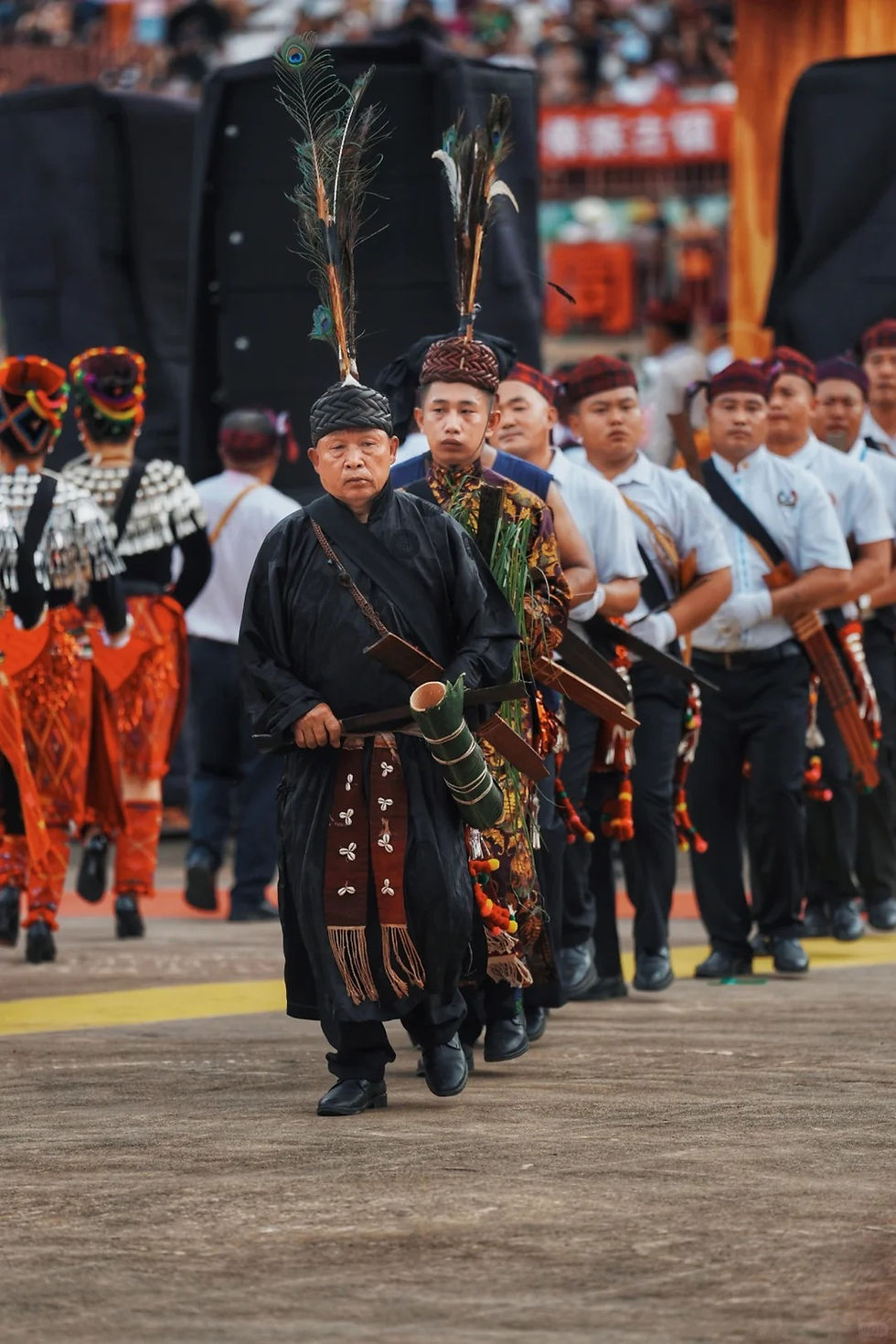
The two people at the head of the column are the reason the whole thing holds together. The Naoshwang and the Naoba are the lead dancers, and the inheritance catalogue recognises them as the operative centre of the tradition. One wears a long robe and a crown built around hornbill and peacock feathers. The other wears a red and green robe in a dragon pattern and carries a Jingpo long knife. Zhao Baozhong, the national-level inheritor, has described their function in plain terms: the lead dancers are the key to a successful Munao because they carry a single unified route and a single set of steps. Without them the plaza would be tens of thousands of people with no shared idea of where to go. That is why the placement rules at the heart of Munao Zongge Festival etiquette and 2027 planning in Dehong are written around the lead pair rather than around the crowd.
What the columns actually do is narrower and more precise than video suggests. The dance runs in two large masses, oriented east, following a fixed sequence. Sources describe about twenty-five named postures in a single round, and a full round takes roughly two hours. Men carry the Jingpo long knife, women carry fans or handkerchiefs, and the silver studs sewn onto the women's jackets strike against each other on the step, adding a layer of percussion that no recording captures properly. The signature movement is a grounded step with a shoulder swing, and it is distinctive enough that the plain sight of it identifies the tradition instantly. Nobody rehearses. The participants have not been drilled. They are following two people at the front who are following a pattern painted on a piece of wood, and it works. Munao Zongge Festival etiquette and 2027 planning in Dehong cannot be learned from a video of the same dance, because the shoulder swing only reads from inside the formation.
Tang Dewen, who has led the column at Mangshi as a Naoba since 2006, put the continuity in personal terms in a 2026 interview: he has been leading for twenty years, and every time he dances there is an elder or a teacher showing the next generation how it is done. That sentence is the honest answer to the question of why a visitor cannot simply copy a video. The route is taught, not guessed. Munao Zongge Festival etiquette and 2027 planning in Dehong therefore starts with a piece of humility: you are joining a transmission that has been running for generations, and you are doing it as a guest on the day.
Three things about the setting that outsiders get wrong
First, there is no backstage. A theatre separates performers from audience physically and in time, with a curtain, a green room and a scheduled start. A Munao ground has none of that. The changing happens in the open, the preparation happens in the open, the elders who hold the ritual authority stand in the open, and the visitors are standing inside exactly the same space. When someone refers to the plaza as a communal setting rather than a venue, this is what they mean, and it has a practical consequence: there is no neutral zone for a camera to occupy without someone noticing.
Second, the plaza is simultaneously sacred ground and public square, and the two uses overlap rather than alternate. In 2026 the main Mangshi round opened at the China Dehong Jingpo International Munao Zongge Cultural Park with more than twenty thousand people inside, and the same prefecture ran an earlier round at Mangshi Square on 20 February, the fourth day of the lunar month, with individual visitors joining the formation alongside the community. Local reporting from the 2026 round describes the circle of dancers assembling around the Munao Shidong and tracing the ancestral migration line, with the route shifting between interweaving and orbiting but never breaking apart. That is a ritual, not a show, and it is happening in a city square.
Third, the same ground hosts the whole social life of the festival. Away from the dance there are brocade and craft stalls, food, evening bonfire singing, and village sports. The Mangshi round in 2026 ran four separate dance sessions plus night concerts and a bonfire evening. The pre-festival evening is often the most useful time for a visitor, because the plaza is quieter, the craft sellers are not overwhelmed, and it is legitimate to ask questions before the crowd makes asking impossible. Munao Zongge Festival etiquette and 2027 planning in Dehong benefits from treating that quieter day as part of the event rather than dead time.
One structural point remains, and it is the one that makes everything else easier. The prefecture spreads the festival across its counties over a period of weeks rather than days. In 2026 the sequence ran from Lianghe between 17 and 23 February, through the Mangshi spring round on 20 February, to the main Mangshi and Longchuan openings on 3 March, with Yingjiang following in early May. Nothing in that arrangement is accidental. It lets communities hold their own rounds with their own organisers, and it gives a traveller a realistic chance of attending two genuinely different events instead of one enormous one. Reading the plaza as one communal setting, repeated in different places on different days, is the frame that makes the rest of the planning coherent. It is also the frame that human-designed travel depends on, because a fixed itinerary cannot absorb a spread of that kind.
Ask Before You Photograph: One Rule That Covers Everything
There is no press pit at a Munao ground, and there is no rule saying photography is forbidden. Both halves of that sentence matter. The festival is public, visitors photograph it constantly, and a great deal of the tradition's current visibility comes from those photographs. What the community regulates is the order of operations. The default is to ask first, and the default applies to every person whose face you intend to keep, not only to the people dressed most elaborately. A visitor who internalises that single habit will pass almost every test the plaza sets, because nearly all of the other misunderstandings are downstream of it. Read that way, Munao Zongge Festival etiquette and 2027 planning in Dehong turns into a single habit rather than a list of prohibitions. Habits survive crowds in a way that rules do not.
Some moments carry more weight than others, and they are worth identifying in advance so you do not discover them through someone else's annoyance. The investiture of the lead dancer's crown at the start of a major round is a ritually loaded sequence, and the person wearing it is assuming an obligation rather than getting into costume. Anything happening at the Munao Shidong itself, the central markers, is inside the ritual frame. The recitation by the zhaiwa chanter, the ancestral offerings, and the elders in ritual dress are all cases where a camera changes the meaning of what is happening. So is any household-specific round, because Dingshuan Munao for a new house or Jieru Munao held before a departure involve real families at a real threshold in their lives. Naming those moments in advance is most of what Munao Zongge Festival etiquette and 2027 planning in Dehong is for.
The practical script is short and works in almost every situation. Approach the person, not the group. Say hello in Chinese if you have any, and use the one phrase that does the job on its own: ke yi pai zhao ma, which asks whether you may take a photo. If language fails, gesture with the camera and wait for an answer that is clearly affirmative. Show the resulting image afterwards, because in a communal setting the photograph is not finished when you take it; it is finished when the person in it has seen it. And accept a refusal the first time, without negotiating, without asking a second person for the same shot, and without taking the picture anyway from a distance. That last clause is where Munao Zongge Festival etiquette and 2027 planning in Dehong stops being abstract.
Four behaviours will get you treated as a problem regardless of how polite your intentions were. Standing in the dancers' path to get a clear frame breaks the route that two lead dancers are carrying for tens of thousands of people, and it is the single most common tourist error. Blocking the Naoshwang or the Naoba is worse, because it disrupts the only steering mechanism the formation has. Flying an unregistered drone over a ritual ground is not merely rude, it is explicitly prohibited by festival management and it is the most damaging single act available to a visitor. And treating the plaza as a backdrop by walking backwards through a column of dancers while filming puts you in physical contact with people who are concentrating on a shared step.
The Jingpo taboos that govern touch are directly relevant to photographers, because cameras make people reach. Do not touch a person's head. Do not pat a shoulder from behind, which reads as an insult rather than a greeting. A man's long knife, his powder gun, his shoulder bag and his clothing are not props: touching them, or stepping over them, is a serious breach, and the prohibition is stated most strictly in relation to women touching or crossing those objects. A photographer who lifts a knife off a table to compose a shot has committed the offence that festival staff most often have to correct. Munao Zongge Festival etiquette and 2027 planning in Dehong is more useful when read as a set of physical boundaries than as a list of courtesies, because in the plaza the boundaries are enforced by touch. There is no version of Munao Zongge Festival etiquette and 2027 planning in Dehong in which a lifted knife is a small matter.
Recording is not the same as extracting
The distinction that resolves most of the difficulty is between documenting an event and extracting material from it. Documentation gives something back: the photograph is accurate, the people in it are named or at least described accurately, the cultural detail is explained rather than exoticised, and the subjects can see what was made. Extraction takes without returning. It crops the crowd to find one striking face, it captions real participants as performers, it sells the image, or it uses the festival as an aesthetic texture for unrelated content. Both use a camera. Only one of them is welcome, and the community can tell the difference within about thirty seconds of watching how a person works.
For anyone producing travel content, this translates into three working rules. Get consent per person and per use, not a blanket permission for a whole event. Credit by name where a name is offered, and use the accurate term for the role rather than the generic label of dancer. Share the finished images back to the people photographed through whichever channel they actually use, which in Dehong is more likely to be a messaging app than an email address. Kiki Holidays works to that standard when it builds itineraries around living festivals, and the reason is not sentiment. Content made this way survives scrutiny, and content made the other way eventually gets a correction attached to it. That standard is what human-designed travel is meant to describe, and it applies to a photograph exactly as it applies to an itinerary.
Two smaller camera rules belong here because they are frequently ignored. Do not photograph someone eating, drinking or resting as though the act were part of the attraction; the meal is the meal. And do not photograph children without a parent's explicit agreement, even when the children are obviously delighted to be noticed. If you are unsure whether a given moment is inside the ritual frame, the safe test is the direction of attention: if the people in front of you are looking at the Munao Shidong or at the lead dancers rather than at each other, put the camera down and watch. Munao Zongge Festival etiquette and 2027 planning in Dehong has a simple photographic spine, and it is that the ritual, not the visitor, sets the tempo.
Ask Before You Join: How to Enter the Line Without Breaking It
Joining is permitted, and saying so plainly removes a great deal of unnecessary anxiety. Munao Zongge is open across ethnic lines and open to men and women alike, and festival organisers in both Mangshi and Longchuan describe visitors entering the formation as a normal part of the day. The rule is not whether you may dance. The rule is where. A formation of twenty thousand people moving along a fixed route has no capacity to absorb someone who enters from the wrong side, and the etiquette exists to protect a shared step rather than to police outsiders. Learn three things about the line and you can join any round in the prefecture with confidence. Those three things carry almost the whole practical side of Munao Zongge Festival etiquette and 2027 planning in Dehong, and not one of them is difficult once it has been said out loud.
The first is the principle of sorting. Enter the column whose dress and role match your own: men with the men, women with the women. In practice this means you walk to the tail of the appropriate mass and follow the people already in it, rather than cutting across the middle to reach the front. The second is the placement of the lead dancers. Do not dance ahead of the Naoshwang, and more generally avoid dancing immediately behind the lead pair, which is a documented taboo rather than a matter of taste. That specificity is what separates Munao Zongge Festival etiquette and 2027 planning in Dehong from generic advice about respecting local customs. Your place is with the main body of the column, and a long way behind the front is exactly where you should be. The third is route discipline. Follow the path the column is already walking, do not shorten it, and do not improvise a shortcut across the plaza.
Leaving correctly is as important as entering correctly, and it is the part visitors get wrong most often. If you need to step out because you are tired or because your child needs water, tell the person immediately behind you before you move, so the line closes smoothly instead of breaking. Then move outwards perpendicular to the column rather than along it. The dancers around you are following a rhythm they have known since childhood, and an abrupt exit in the wrong direction forces everyone nearby to adjust. Staff will also ask visitors not to wander around inside the plaza. The ground is a dance floor, not a promenade, and promenading through a working formation is the behaviour that most reliably turns a welcome into a caution. Nothing in Munao Zongge Festival etiquette and 2027 planning in Dehong is more reliably rewarded than a clean exit.
What to wear, and what not to do with your hands
Festival management in Dehong publishes dress guidance and it is more specific than a general request to dress modestly. Overly revealing clothing is prohibited. Sun hats and dark glasses are expected to come off while you are dancing, which is a practical instruction as much as a courtesy, since they interrupt the visual line of the column and the person beside you needs to see your movement. Local guidance recommends ethnic dress, and in practice a large number of domestic visitors rent or buy a Jingpo outfit for the day, which is welcomed when it is done as participation rather than as costume. If you are not wearing ethnic dress, wear something neat and unremarkable, and leave the fluorescents at the hotel. Dress is the easiest part of Munao Zongge Festival etiquette and 2027 planning in Dehong to get right, and the most visible to get wrong.
There are also explicit prohibitions on behaviour inside the formation, and they are worth treating as hard rules. Do not improvise moves or invent a style of dancing that no one around you is doing. Do not create deliberately comic or exaggerated gestures. Do not shout impromptu crowd calls to provoke a reaction, because several such calls already carry meanings in Jingpo custom and inventing new ones around them is both confusing and disrespectful. And do not alter the traditional use of the red fan. If you are given a fan or pick one up, use it the way the dancers around you are using it, because the fan has a conventional function within the step rather than being a decorative accessory. This is the section of Munao Zongge Festival etiquette and 2027 planning in Dehong that surprises visitors most often.
The ritual zones are a separate category, and they are not a matter of degree. The Mupai ritual house and the numen post are closed to visitors unless the host has given permission. These are the places where the offering and the ancestral business of the festival take place, and no amount of curiosity justifies an entry. The same applies to photographs taken from outside towards those structures when a ritual is in progress. A visitor who wants to understand what happens inside them should ask a host, an elder, or a staff member at the cultural park, and should expect the answer to be an explanation rather than an invitation. Munao Zongge Festival etiquette and 2027 planning in Dehong is not complete without ironing this boundary out in advance, because it is the one line that has no grey area.
Etiquette if you are invited into a Jingpo home
The festival is the public face of a community whose private etiquette is equally codified, and an invitation to eat is common during the festival weeks. The published guidance from Lianghe county government is precise and can be summarised without losing much. Sit where you are directed rather than standing about, and never enter a bedroom. Do not whistle indoors. Do not cross your legs in a way that points a foot at someone, and women should not sit with a chin propped on the hand, since that posture belongs to mourning. Accept tobacco or liquor with both hands. When drinking, use the cup lid rather than the jar itself, and after each person has drunk, wipe the rim before passing it on, with the eldest drinking first.
At the table, the sequence carries meaning. A host who hands you a bamboo gift basket containing rice wine, rice liquor, hard-boiled eggs and glutinous rice is offering a formal welcome, and the correct response is to take a first sip and pass the container along rather than drinking alone. The chicken head belongs to the eldest, and the feet belong to the children, so a guest should touch neither. Leaf plates must not be laid down upside down. Dog meat is not eaten, and the story behind that prohibition is that the dog is credited with bringing grain to humanity. Do not fire three gunshots near a village, because three reports signify a death. If you remember nothing else from this paragraph, remember the two-hand rule and the seniority rule, because both are visible at a glance and both are constantly observed. Both are the sort of detail human-designed travel itineraries exist to brief in advance rather than discover on the day.
Do Not Turn Dress, Faces or Children Into Props
This is the instruction that visitors find hardest to follow, because it asks for a distinction that has no obvious visual marker. Wearing the dress is not the problem. Using the dress is. A visitor who rents a Jingpo outfit and joins the column as a participant is adding to the plaza. A visitor who assembles three people in brocade against a wall and directs them into a photogenic arrangement has converted a living tradition into a set. The materials are identical. The relationship is inverted. Once you see that the difference lies in who is deciding what happens next, the rest of the etiquette in this section follows logically. That distinction sits at the centre of Munao Zongge Festival etiquette and 2027 planning in Dehong, and it is the one visitors are warned about least often.
The dress itself is not neutral. Jingpo festival clothing is a dense information system. The brocade patterns are inherited and named, the silver studs on a woman's jacket are placed according to convention, and the long knife a man carries is a personal object that is also, in the community's understanding, a sacred one. Above all, the hornbill and peacock feathers on the lead dancer's crown are not generic festival decoration. The hornbill appears in the origin story as one of the birds that led the dance, and the Jingpo revere it for that reason, along with the water buffalo. A crown is therefore bound to a role and a responsibility. Getting that hierarchy right is part of what human-designed travel means in practice, which is to build a trip around a living culture rather than around a photograph of one. Renting a jacket and a skirt to dance in is a normal thing to do. Borrowing the crown to take a photograph is a category error, and a serious one.
The characteristic failure is subtle and usually well intentioned. It looks like asking an elder to hold a pose again because the first frame was slightly blurred. It looks like positioning a group of children in the centre of a line so the composition is symmetrical. It looks like describing the participants in a caption as performers, or writing that a grandmother posed for the camera in a way that centres the photographer's experience rather than her own. None of this is hostile. All of it converts a person into a component of somebody else's picture, and in a communal setting where everyone can see everyone, it is visible from across the plaza. Munao Zongge Festival etiquette and 2027 planning in Dehong asks for a level of self-awareness that a normal tourist itinerary never requires.
Children, families and the limits of a photograph
Munao Zongge is a family festival in the most literal sense: the participants include children carried on backs, toddlers walking between adults, and teenagers in their first full round. That makes it photographically irresistible and ethically demanding at the same time. Four rules cover it. Never photograph a child without the explicit agreement of a parent or guardian who is present. Never move a child, lift a child, or reposition a child inside the plaza, even to help. Never use a child as a compositional element by standing behind them so they frame the lead dancers. And never post an image of an identifiable child alongside location detail that would let a stranger find the family, which is a basic safety rule that travel publishing regularly ignores.
There is also a stamina dimension to the etiquette that no official notice spells out. A full round runs for around two hours and the pace does not ease for guests. Leaving when you are finished is correct behaviour, not an admission of weakness, and it is the reason the exit protocol matters so much. Visitors who try to last the whole session out of politeness and then stumble out through the middle of a column cause exactly the disruption that the route discipline exists to prevent. Judging your own limit honestly is part of respecting the formation. It is the kind of judgement a human-designed travel itinerary is meant to make unnecessary, by pacing the days around a two-hour round rather than around a checklist.
For anyone producing branded content, the standard to hold is consent, credit and reciprocity taken together. Consent means asking each person whose image you will use, for the specific use you have in mind. Credit means naming the role correctly, which for the lead dancers means Naoshwang and Naoba rather than performer, and for everyone else means a person with a name if one is given. Reciprocity means the community should be able to see and use what was made. Kiki Holidays applies that standard when it builds a human-designed travel itinerary around a living festival, on the straightforward reasoning that a tradition is not a location and cannot be licensed like one.
The last thing to avoid is the aesthetic reflex that treats everything non-Western as timeless and anonymous. The Jingpo of Dehong are not a tableau from the past. They run businesses, staff government offices, study at universities, and argue about how their festival should be staged, including, as Longchuan's tourism bureau noted in a 2025 written reply to a county political consultative conference proposal, about the fact that other counties in the prefecture running their own Munao rounds has diluted the distinctiveness of Longchuan's claim as the home of the tradition. That is a live civic argument among the people whose festival it is. A visitor who writes about the event as though it were staged for them has missed the entire subject. Munao Zongge Festival etiquette and 2027 planning in Dehong becomes considerably simpler to get right once the people in the plaza are understood as hosts making their own decisions rather than as scenery.
A Mangshi-Based Planning Framework for the Festival Window
The reason to base a festival trip in Mangshi rather than moving between counties every night is that Mangshi is the prefectural seat, and the prefecture-level main venue, the China Dehong Jingpo International Munao Zongge Cultural Park, sits inside it. Mangshi also has the only airport in Dehong, and the county holds the deepest stock of accommodation, food and ground transport in the prefecture. In the first half of 2026 the airport handled 1.78 million passengers, and its full-year throughput has passed three million, which makes it the first regional airport in Yunnan to reach that tier. Lodging data confirms the concentration: across the 2026 National Day holiday, Mangshi's occupancy growth of 16.5 per cent led every other county in the prefecture. Staying put and radiating outwards is the single decision that most reduces friction. It is also the move that turns Munao Zongge Festival etiquette and 2027 planning in Dehong from something you read into something you can actually do.
The prefecture is small enough for that to work. Dehong covers roughly 11,500 square kilometres and contains two cities and three counties: Mangshi, Ruili, Longchuan, Yingjiang and Lianghe. Longchuan, the declared home of the tradition and the place with the most complete transmission of the dance, is a drive of roughly two hours from Mangshi. Ruili on the Myanmar border is comparable, Yingjiang is nearer, and Lianghe is closer still. Each holds its own round at its own time, and because the prefecture staggers the calendar, two different rounds in one trip is a realistic goal rather than an ambitious one. The framework below assumes a seven to nine day trip with Mangshi as the fixed base.
The five phases
Phase zero, ninety to sixty days out, is about locking only what is refundable. Book a flight to Dehong Mangshi Airport and a room in Mangshi with free cancellation, and accept that you cannot yet pin down the exact programme. This is the point at which most travellers over-commit, buying non-refundable tickets to a festival whose official schedule has not been published. Munao Zongge Festival etiquette and 2027 planning in Dehong rewards patience here more than anywhere else, because the counties announce their rounds at different times and a fixed plan made too early is a liability rather than an asset.
Phase one, sixty to thirty days out, is where you choose anchors rather than build a full itinerary. Pick two events, not five. One should be a large prefectural round at Mangshi, because that is where the scale and the organisational completeness are, and the other should be a smaller county round, because that is where the atmosphere is closer to a village and the ratio of visitors to residents is healthier. Longchuan is the obvious second anchor. Yingjiang suits travellers who would rather stand at the edge of a smaller formation, and its county also holds strong birdwatching along the Yingjiang river corridor if you want a second reason to go. Resolve the second anchor by reading the county culture and tourism bureau notices, not by trusting aggregator listings.
Phase two, thirty to seven days out, is confirmation week. Verify the prefectural and county calendar from the official channels listed in the next section. Confirm your shuttle plan for the main venue, because the streets around the primary plaza go under traffic control and private cars are not admitted. Decide the dress question, and if you intend to wear festival dress, arrange it in Mangshi rather than hoping to find something on the day. And re-check the weather: Dehong's rainy season runs through the late summer and early autumn, and the comfortable window is roughly October to April, which is also when the lunar new year and the festival sit. Munao Zongge Festival etiquette and 2027 planning in Dehong is, in practice, a sequence of confirmations rather than a sequence of bookings.
Phase three is the festival itself, and the rhythm that works is deliberately undramatic. Dance in the morning, because the opening sequence and the crowning of the lead dancers happen then and the formation is at its best. Rest through the middle of the day, which is hot and bright, and which is when dehydrated visitors make their worst decisions. Return for the late afternoon and evening, and finish at Mangshi Square, where a communal round open to all ethnic groups runs nightly at half past seven and functions as a lower-pressure rehearsal for anyone who found the main plaza overwhelming. Doing one session well is worth more than doing three badly.
Phase four is the decompression days after the festival, and skipping them is a mistake. The days either side of the festival are the only time in the trip when Dehong is not at maximum density. Mangshi itself has enough to fill two of them: the Golden Pagoda on Leiyarang hill, a 4A site with a 73 metre gilded stupa and a gate price reported at around 40 yuan, the matching Silver Pagoda across the hill, the tree-wrapped pagoda in the older part of town, and Bingwu Street, whose market cycles on a five-day rotation and is where you see the everyday Dehong rather than the festival one. Add a day at Chudonggua village for the De'ang drum dance and sour tea, and an evening at the Xinwanchang night market, and the trip stops feeling like a single-event dash.
Transport, weather and money
Transport needs an honest statement, because Dehong's rail link is not finished. The Dali to Ruili railway opened its Dali to Baoshan section in July 2022, and the section that will serve Mangshi and continue to the border is still under construction as of 2026, alongside the Ruili to Menglian expressway. There is therefore no train to Mangshi in 2027, and the realistic access options are a flight into Dehong Mangshi Airport or a long road transfer. Within the prefecture, plan on cars rather than buses for the county rounds, and on the official shuttle for the main venue, which costs a few yuan and removes the parking problem entirely. Travellers who tried to self-drive to the 2026 main venue reported queueing for hours to leave afterwards.
Weather is simple. The festival sits at the tail of the dry season, the days are warm and bright, and the sun at plaza level is stronger than the temperature suggests, so sun protection matters and so does a light rain layer. Mangshi sits at roughly 900 metres, which is low enough that altitude is not a factor anywhere in Dehong, unlike much of the rest of Yunnan. Budget-wise, treat any number you read as provisional. The only figure worth planning around is the trend rather than a specific price: festival week is the single most expensive period of the Dehong year for accommodation, so booking early is a cost-control measure, not just a convenience. Munao Zongge Festival etiquette and 2027 planning in Dehong should end in a plan that is funded, dated and cancellable, not in a plan that is merely detailed.
What Is Confirmed for 2027, and What Still Is Not
This section exists because most festival guides collapse two different kinds of information. Some facts about Munao Zongge are structural: they were settled decades ago by statute and by heritage listing, and they will hold in 2027 whatever the organisers announce. Other facts are annual: they are decided by the prefecture and by individual counties, published close to the event, and change from year to year. Mixing the two is how travellers end up booking flights around a date that turns out to be a plenary decision rather than a performance slot. Munao Zongge Festival etiquette and 2027 planning in Dehong gets much easier once the two categories are kept apart.
What is structurally fixed
Three things are safe to rely on. First, the festival is a statutory ethnic festival of Dehong Dai and Jingpo Autonomous Prefecture. The prefectural people's congress fixed it in 1983 to the fifteenth and sixteenth days of the first lunar month, and that is a standing decision rather than an annual announcement. Second, it is a national-level intangible cultural heritage item, listed in the first batch announced on 20 May 2006 under code X-11 with Longchuan county as the declaring region, so the tradition itself has formal protection regardless of any given year's programme. Third, the lunar arithmetic is a matter of the calendar rather than of policy. In the standard Chinese lunisolar calendar the fifteenth day of the first lunar month in 2027 falls on Saturday 20 February and the sixteenth on Sunday 21 February. That date pair is reliable. It is also not the same thing as a 2027 programme.
What is not confirmed, and must not be assumed
Everything about the 2027 event itself is unconfirmed at the time of writing. That includes the dates on which the prefecture's main round will actually run, the dates on which each of the five county-level units will hold its own round, the venue list, the number of dance sessions, the composition of the evening programme, the shuttle routes, the traffic-control boundaries, the standing policy on drone permits, and the administrative holiday notice that tells residents which days the prefecture will close. None of this is secret and none of it is controversial. It is simply published late, on an annual cycle, and anyone who claims to have the 2027 schedule now is either guessing or recycling a 2026 notice.
The 2026 calendar shows how wide the spread can be, and it is the best available guide to what 2027 might look like. That year the prefecture did not run a single two-day event. Instead it ran a sequence: an early Mangshi Square round on 20 February, the fourth day of the lunar month, with visitors joining the formation alongside local residents; a Lianghe programme from 17 to 23 February built around the county's hulusi culture festival and performed in the county sports park; the main Mangshi opening at the prefectural cultural park on 3 March, the fifteenth day, drawing a crowd of over twenty thousand; a Longchuan opening the same day at Pengsheng Square in Jinghan township, staged as the forty-second Pengsheng Tongken round; and a Yingjiang follow-up programme on 3 and 4 May. A 2027 sequence could plausibly stretch from late January to May on the same logic. That spread is the most important fact in Munao Zongge Festival etiquette and 2027 planning in Dehong, because it means a fixed two-day plan is the wrong shape.
County-level unit | 2026 round as precedent | Calendar basis |
Mangshi | Spring round at Mangshi Square, plus the prefectural main opening at the cultural park | Fourth day and fifteenth day of the first lunar month |
Longchuan | Forty-second Pengsheng Tongken round at Pengsheng Square, Jinghan township | The same fortnight, staged by the village tradition |
Lianghe | Week-long programme inside the hulusi culture festival at the county sports park | Late in the first lunar month |
Yingjiang | Follow-up programme in early May | Separate spring window |
Ruili | Border and mountain-village venues | Announced separately |
Where to confirm, and when to book
The authoritative sources are narrow and easy to name. The Dehong prefectural culture and tourism bureau publishes the prefectural calendar, and the culture and tourism bureaux of Mangshi, Longchuan, Yingjiang, Lianghe and Ruili publish their own county rounds. Each county also runs an official media channel, and in practice those channels break the news first, with the prefectural portal and the county government sites following. Watch specifically for two documents rather than general coverage: the festival notice that lists venues and session times, and the prefectural holiday notice that sets the days off for residents. The holiday notice is the one that tells you how congested the roads will actually be. That reading is what a human-designed travel plan is built on, and a generic package cannot do it on your behalf.
On timing, the practical rule is that a refundable plan can be made four months out and a committed plan should wait until the county notice lands, which in recent years has been weeks rather than months before the event. If you are working with a fixed holiday allowance and cannot wait, book flights and a cancellable room, tell yourself explicitly that you are holding a place rather than holding a seat at a specific session, and treat any date you have written down as provisional. Munao Zongge Festival etiquette and 2027 planning in Dehong is more honest when it says this out loud than when it offers a confident table of dates that no official body has published.
For scale, the recent precedent numbers are worth having so that a published programme can be sanity-checked when it arrives. Mangshi's main 2026 opening put more than twenty thousand people in the plaza. Longchuan's 2024 round recorded roughly 160,000 participants across the festival with more than twenty thousand inside the dancing ground. In 2024 the prefectural culture and tourism bureau said the state planned twelve Munao rounds that year with total participation expected to exceed one million visits. When the festival coincided with Spring Festival in 2025, Dehong reported 2.1088 million visitor trips and 2.357 billion yuan in tourism spending during the holiday, an increase of 22.12 per cent. Over the nine-day Spring Festival holiday in 2026 the state recorded 2.3684 million domestic visitor trips, up 12.27 per cent, and domestic tourism spending of 2.203 billion yuan, up 16.92 per cent. Any published 2027 programme should look broadly consistent with that pattern.
One specific number deserves a caveat of its own. Longchuan's round in 2026 was the forty-second in the Pengsheng Tongken sequence, which suggests the 2027 round would be the forty-third. That inference is reasonable but it is an inference. The numbering belongs to a village tradition with its own record-keeping, and it should be read off an official notice rather than calculated by a visitor. The same caution applies to the names of the named Munao subtypes on a given day, which determine whether you are attending a harvest round, a house-warming round or a memorial round. Those are not interchangeable occasions, and the programme is the only reliable place to find out which one you are walking into.
Where the Festival Actually Happens: A Venue Map of Dehong
One of the most common planning errors is to treat Munao Zongge as a single destination. It is a prefectural tradition with several hosts, and the venue determines the character of the day more than the date does. A visitor who attends the prefectural main venue in Mangshi and a village round in Longchuan in the same trip will come away understanding the tradition far better than someone who attends the main venue three times. The table below maps the venues by county-level unit, with what each one actually offers, rather than ranking them, because there is no sensible ranking: the right choice depends on whether you want scale, intimacy, or a combination of culture and border landscape.
County-level unit | Anchor venue | Character of the round | Best for |
Mangshi | China Dehong Jingpo International Munao Zongge Cultural Park; Mangshi Square for the spring round | Prefectural main venue, largest formation, most complete programme | First-time visitors and anyone who wants the full-scale version |
Longchuan | Pengsheng Square, Jinghan township | Declared home of the tradition, most complete transmission of the steps and routes | Travellers who want the deepest and most traditional round |
Yingjiang | Yunyan Mountain Jingpo cultural park and Kachang | Smaller, more village-centred, strong birdwatching in the county | Repeat visitors and photographers working at a distance |
Ruili | Border venues, sometimes held in mountain villages | The dance combined with the China-Myanmar border landscape | Travellers who want culture and border scenery in one trip |
Lianghe | County sports park, inside the hulusi culture festival | Calmer crowds and an easier day out | Families and anyone who finds the main venue overwhelming |
Mangshi is the anchor for most trips and it earns the role. The cultural park is the prefecture-level main stage, the formation is the largest anywhere in Dehong, and the supporting programme is the most complete, running across several dance sessions plus concerts, craft markets and a bonfire evening. Mangshi also carries the deepest practical infrastructure, and a nightly communal round at Mangshi Square at half past seven gives you a second chance at the dance on days when the main venue is too crowded. The county also holds the Jingpo museum, whose collection runs to more than four hundred objects, and that is the single best place to spend a rainy half-day before the festival rather than during it.
Longchuan matters disproportionately for anyone serious about the tradition. It is the county named in the national heritage listing as the declaring region, it describes itself as the home of Munao Zongge, and it holds the most complete and most standardised transmission of the routes and steps. The county's culture and tourism bureau acknowledged the pressure in a September 2025 written response to a proposal put before the county's political consultative conference, noting that Munao rounds in other parts of the prefecture had diluted Longchuan's distinctiveness and stating that it was working with the prefectural bureau and other counties on a more coherent allocation of dates. That is a useful signal for a visitor: the county is actively protecting the depth of its own round, which is exactly what a traveller looking for the traditional form should want.
The smaller venues repay the effort in a different currency. Yingjiang's round sits in more open, more rural settings, and the county combines it with the Yingjiang river corridor, one of the better birdwatching areas in western Yunnan. Ruili puts the dance next to the border, which means the trip carries a second subject without a second journey. Lianghe wraps its round inside a hulusi culture festival and a programme that includes intangible-heritage parades and a courtyard theatre production, and it is the least overwhelming option for a family with young children. Munao Zongge Festival etiquette and 2027 planning in Dehong is easier to get right when the venue is chosen for the kind of day you actually want rather than for the venue's reputation.
Two things apply at every venue without exception. Traffic control around the primary plaza is standard, so plan on the official shuttle or a drop-off outside the boundary rather than a car at the gate. And every venue has a plaza and a perimeter, with the ritual structures at the centre and the stalls, food and craft activity around the edges. Understanding that geography before you arrive is what lets you be useful rather than obstructive, because the perimeter is where a visitor with a camera and no appointment belongs, and the centre is where the community does its own work.
The Etiquette Checklist and What to Verify Before You Book
Everything above compresses into two short reference tables, one for conduct and one for planning. The first can be read the night before you go. The second should be read before you spend anything. Together they are the working version of Munao Zongge Festival etiquette and 2027 planning in Dehong, and they are deliberately short, because a checklist that runs to several pages does not get used in a crowded plaza.
Situation | Do | Avoid |
Approaching a person with a camera | Ask first, one person at a time, and show the resulting photograph afterwards | Photographing from a distance after a refusal, or approaching someone else for the same frame |
Joining the column | Enter at the tail of the mass that matches your dress and gender | Dancing ahead of the lead pair or directly behind them |
Moving through the plaza | Follow the existing route and tell the person behind you if you step out | Cutting across the formation or promenading inside the dance ground |
Dress | Neat clothing or festival dress worn as participation | Revealing clothing, or sunglasses and sun hats worn while dancing |
Improvised behaviour | Copy the step of the dancers beside you | Inventing moves, comic gestures or crowd calls, or altering the red fan sequence |
Ritual structures | Ask a host or staff member and accept an explanation | Entering the Mupai ritual house or the numen post area, or filming into them |
Handling objects | Keep your hands off knives, shoulder bags and clothing | Touching or stepping over personal and ritual objects |
Children | Ask a parent present, and never reposition a child | Photographing a child without agreement, or posting location detail alongside the image |
Equipment | Register anything you intend to fly, and expect a refusal | Flying any drone that has not been registered above a ritual ground |
Tiredness | Leave cleanly, perpendicular to the column | Trying to last the full two-hour round out of politeness |
The second table is the one that protects your money. It lists what can be treated as settled and what must be confirmed before a non-refundable commitment. Read it as a gate rather than a suggestion: nothing in the right-hand column should be resolved by inference, by a search result, or by a travel listing that has copied a previous year's dates.
Item | Status to work from |
Festival date window | Structurally fixed to the mid-month days of the first lunar month, which in 2027 places those two dates on 20 and 21 February |
Prefectural main round dates and venue | Not published; confirm with the prefectural culture and tourism bureau |
County round dates and venues | Not published; confirm with each county's culture and tourism bureau |
Number and timing of dance sessions | Not published; confirm from the festival notice |
Shuttle routes and traffic control | Not published; confirm from the festival notice |
Drone policy and permits | Assume refusal by default; confirm with the organising committee |
Prefectural holiday notice | Not published; watch for the administrative notice that sets residents' days off |
Transport to Dehong | No rail link in service; fly into Dehong Mangshi Airport or plan a road transfer |
Accommodation | Book cancellable early; festival week is the peak pricing window of the Dehong year |
Weather | Comfortable window roughly October to April; expect strong sun and a light rain layer |
Two habits make both tables work in practice. The first is to arrive one day before the round you intend to watch, so that you spend the eve of the festival walking the venue, finding the shuttle stop and locating the perimeter rather than doing all three under pressure on the morning itself. The second is to travel with a named contact at the venue, whether that is a local guide, a hotel manager who knows the organisers, or a travel designer with pre-existing relationships in the county. Festival etiquette is easier to follow when somebody local is quietly telling you which side of the plaza to stand on.
Frequently Asked Questions
Q1. What are the confirmed dates for the 2027 festival?
Two kinds of fact sit behind that question. The window is structural, because the prefectural people's congress fixed the festival to the mid-month days of the first lunar month in 1983, and in 2027 those two days fall on Saturday 20 February and the Sunday that follows. The programme is annual: which round runs where, on which days, in which plaza, is published close to the event by the prefecture and by the five county bureaux, and nothing should be treated as settled until those notices appear.
Q2. Can foreign visitors join the dance, or is it for Jingpo people only?
Anyone may join. The festival admits anyone who wants to dance, regardless of ethnicity, and organisers in Longchuan in particular treat visiting participants as an ordinary feature of the day. What is regulated is placement rather than admission. Sort yourself into the column that matches your dress and gender, enter at the back, keep clear of the leading pair, and move the way the dancers in front of you are moving.
Q3. Is photography allowed at the plaza?
Yes, and the convention is simply to ask. Approach the individual rather than a group, request permission in Chinese if you have any, show the person the frame you took, and treat a refusal as final. Certain sequences belong to the ritual rather than to the public: the crowning of the lead dancer at the opening of a major round, anything happening at the central timber markers, the chanter's recitation, and any round tied to a particular household. Drones flown without registration are banned outright and are the most serious single mistake a visitor can make.
Q4. How long does one round of the dance take, and how hard is it?
One full round takes about two hours and works through roughly twenty-five named postures. The tempo is set by the lead dancers and does not slow down for visitors, and nobody in the formation has rehearsed, because the whole thing runs off a route painted on timber. Leave when you are tired. Move outwards at right angles to the column and speak to the person behind you before you step away.
Q5. Should I wear Jingpo clothing?
Plenty of domestic visitors hire or buy an outfit for the day, and local organisers welcome it when the intention is to participate rather than to dress up for pictures. Guidance prohibits clothing that is too revealing, and eyewear or headwear that obscures the face is expected to be removed while you are in the formation. The one item to leave alone is the feathered headdress worn by the lead dancer, which belongs to a ritual role rather than to the festival wardrobe.
Q6. What is the best base for a festival trip in Dehong?
Mangshi. It is the prefectural seat, it contains the prefecture's principal festival ground, and it is the only place in Dehong with an airport, which is why it also holds the densest supply of hotels and restaurants. Longchuan is around a two-hour drive, Ruili is a similar distance, and Yingjiang and Lianghe are closer, so a single base reaches two county rounds without repacking.
Q7. Is there a train to Mangshi?
Not yet. Rail reached Baoshan from Dali in July 2022, and the stretch running south through Mangshi towards the border was still under construction in 2026, as was the expressway to Menglian. The realistic approach is a flight into Dehong Mangshi Airport or a long drive. For the principal festival ground, use the official shuttle: the streets around the primary plaza are closed to private vehicles, and drivers who ignored that were stuck for hours leaving afterwards.
Q8. When is the best time of year to be in Dehong at all?
Roughly October to April. The wet months fall in late summer and early autumn, when mountain roads and outdoor plans suffer, so winter and early spring are the comfortable stretch, and the festival sits at the end of it because it follows the first lunar month. The city itself stands at about 900 metres, low enough that elevation is a non-issue anywhere in the prefecture, in contrast to much of the rest of Yunnan.
Q9. What does the festival actually cost to attend?
Treat any figure as provisional until you have confirmed it at the point of booking. The one structural fact is that accommodation peaks during festival week more than at any other time of the Dehong year, which makes booking early a cost-control measure rather than a matter of convenience. Local shuttle transport to the main ground costs only a few yuan, gate prices at the main cultural sites are modest, and the county rounds are open events rather than ticketed performances.
Q10. Where should I check for the official 2027 announcement?
Start with the prefectural culture and tourism bureau for the state-level calendar, then the five county bureaux for their own rounds. There is also a county-level media channel in each place, and in recent years those have carried the news first. Two documents matter most: the festival notice listing venues and session times, and the ruling that tells residents which days the prefecture closes.
The Munao Zongge Festival is one of the few genuinely large living rituals in China that a visitor can still join rather than merely watch, and that is precisely why it needs to be approached with some care. A crowd of twenty thousand people tracing a route inherited from an origin story has no room in it for a visitor who treats the plaza as a photo set, and no shortage of room for one who asks, dresses sensibly, enters at the tail and steps out cleanly when they are tired.
The planning side is less romantic and more consequential. The festival is fixed to the first lunar month by a decision taken by the prefectural people's congress in 1983, and its dates in 2027 fall on 20 and 21 February on that basis. Everything else about the year, from the venue list to the number of sessions to the shuttle routes to the holiday notice, comes from official channels on an annual cycle and is not yet published. A traveller who holds a refundable plan and waits for the county notices is doing the right thing. A traveller who has already paid for a specific session in a specific plaza is doing something else.
Read together, Munao Zongge Festival etiquette and 2027 planning in Dehong reduce to a single posture. Treat the people in the plaza as hosts, treat the dates as provisional until a bureau confirms them, and let the ritual set the tempo rather than your itinerary. Everything in this guide is a way of holding to that. The dance has been running for a very long time, it will still be running in 2027, and the only thing a visitor can get wrong is the manner of arriving.
Kiki Holidays designs human-designed travel itineraries in Yunnan, including festival weeks in Dehong built around confirmed county programmes rather than assumed dates. If you want a plan that is dated accurately and cancellable in the meantime, that is the kind of work involved.
Sources and Fact-Check Trail
- China Intangible Cultural Heritage Network, project record for Jingpo Munao Zongge, item 459, code X-11, first national batch announced 20 May 2006, declaring region Longchuan county, protection unit Longchuan county cultural centre.
- Longchuan county culture and tourism bureau, written reply to a county political consultative conference proposal on strengthening the Munao Zongge brand, 22 September 2025.
- Lianghe county government, published guidance on Jingpo etiquette and taboos.
- China Daily Yunnan, report on the opening of the 2026 Mangshi Munao Zongge Festival at the China Dehong Jingpo International Munao Zongge Cultural Park, 4 March 2026.
- China News Service, Munao Zongge round draws twenty thousand dancers to Mangshi, 3 March 2026, including interview material with lead dancer Tang Dewen.
- Dehong Net, joint opening of the Mangshi and Longchuan rounds on the fifteenth day of the first lunar month, 4 March 2026, including the forty-second Pengsheng Tongken round in Jinghan township.
- CNR Dehong, Mangshi spring round at Mangshi Square and the Lianghe programme, 22 February 2026.
- Xinhua, report on the Munao Zongge ground as a platform for cross-community exchange, 27 February 2024, including interviews with national-level inheritor Zhao Baozhong and Dehong culture and tourism bureau deputy director Yang Min.
- Guangming Daily, feature on new arrangements of Jingpo melodies and the state of Dehong tourism, 5 August 2026.
- Yunnan Net Dehong channel, review of cultural development and 2025 tourism figures for Dehong prefecture, 23 September 2026.
- Yunnan Daily via Yunnan News, analysis of Munao Zongge as an emerging cultural tourism asset, including 2025 and 2026 Spring Festival visitor figures.
- Mangshi media centre and Dehong Net, National Day holiday tourism summary for 2026, including airport throughput and accommodation growth by county.
- Dehong prefecture 2020 census tabulations, resident population by ethnic group.
- Chinese lunisolar calendar tables for 2027, giving the first lunar month's fifteenth day as 20 February 2027.


Comments