When Is the Best Time to Visit Yunnan? A Season-by-Season Travel Guide

Introduction
Yunnan is one of those rare destinations that can be visited all year round, yet the difference between a good trip and a great one often comes down to choosing the right season. Located in China’s far southwest, the province sits at the crossroads of tropical heat, Himalayan chill, and monsoon moisture. Many travelers arrive with expectations shaped by the four distinct seasons of northern or eastern China, only to find that Yunnan follows its own calendar. If you are wondering about the best time to visit Yunnan, the answer depends less on the month and more on what you want to experience.
Three forces dominate Yunnan’s weather: the South Asian monsoon, elevation, and mountain barriers. The monsoon brings concentrated summer rainfall, while altitude creates sharp temperature differences within short distances. Mountain ranges further split the province into microclimates, meaning that a few hours of driving can carry you from subtropical valleys to alpine meadows. For travelers, it is helpful to think of Yunnan not in terms of spring, summer, autumn, and winter, but in three practical seasons: the rainy season from June to mid-October, the cool dry season from November to February, and the hot dry season from March to May. Each offers a different face of the province, and each rewards a different style of travel.
This guide walks through those seasons in the order they appear in the original source material, explains how altitude changes the experience, and pinpoints the small windows when high-altitude trekking is possible. By the end, you will know not only when to go, but also where to go within each season.
How Yunnan’s Climate Works: Monsoon, Altitude, and Mountains
Before diving into each season, it is worth understanding why Yunnan feels so different from the rest of China. The South Asian monsoon is the single most important driver. Every year, moisture pulled from the Bay of Bengal pushes northward and reaches Yunnan between June and early October. During these four months, rain falls across the entire province, from the tropical lowlands of Xishuangbanna to the high-altitude grasslands of Shangri-La. For travelers escaping the oppressive heat of the Yangtze River basin, North China, or even the northeast, Yunnan’s rainy season is a natural air-conditioner.
The second force is elevation. Yunnan’s average altitude is high, and the province sits on a plateau that rises toward Tibet. Because temperature drops roughly six degrees Celsius for every thousand meters of ascent, a single province can contain tropical, subtropical, temperate, and alpine zones. The third force is mountain barriers. Long north-south ranges such as the Wumeng, Ailao, Wuliang, and Gaoligong mountains act like walls that redirect monsoon moisture, block winter cold air from the north, and create sheltered valleys with their own local climates. These three forces together mean that asking about the best time to visit Yunnan without specifying a destination is a little like asking about the best time to visit Europe.
The Rainy Season (June to Mid-October): Cool, Green, and Mushroom-Friendly
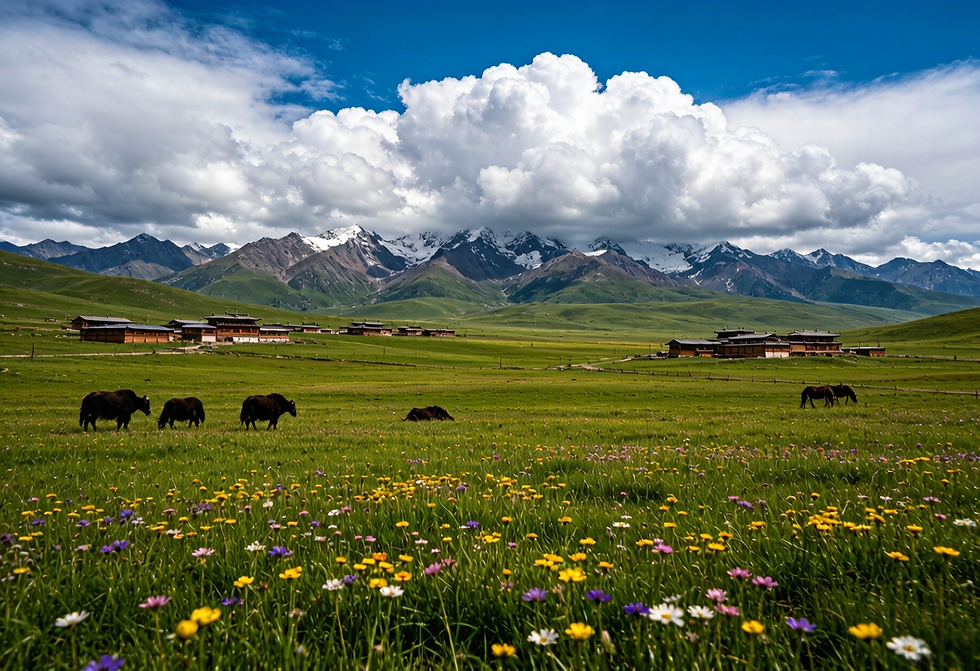
The rainy season is when Yunnan becomes one of the coolest places in China. While much of the country sweats through July and August, Yunnan enjoys mild temperatures made possible by the combination of low latitude, high altitude, and monsoon cloud cover. This coolness is province-wide. Even Shangri-La, where you may still need a down jacket, and Xishuangbanna, where tropical humidity lingers, feel refreshingly mild compared with the oven-like heat of the eastern plains. In fact, the comfortable rainy-season weather extends beyond Yunnan into neighboring Liangshan, Bijie, Anshun, Liupanshui, and even the Shan Hills across the border in Myanmar.
For food travelers, the rainy season is the best time to visit Yunnan. Wild mushrooms appear across the forests, and different regions specialize in different varieties. If matsutake is your goal, head to the two-hundred-kilometer radius around Lijiang, including Jianchuan, Lanping, Shangri-La, and Tacheng. For porcini and ganba mushrooms, the area within two hundred kilometers of Kunming is the place to be, covering Yuxi, Chuxiong, and Shiping. Those who want a Southeast Asian rainy-season flavor should turn south to Xishuangbanna, Pu’er, Lincang, Dehong, and the Nu River valley south of Liuku. Near Sichuan, Zhaotong offers a convenient entry point, while the emerald rice terraces of Yuanyang are often wrapped in rising mist that is as dangerous to photograph as it is poetic to watch.
Rain does worry some visitors, but most monsoon rain falls as short showers rather than all-day downpours. Daily life continues, and the misty light over Erhai Lake at dawn is one of the season’s special gifts. That said, you should still be prepared for the possibility of five consecutive rainy days, especially in the north, where temperatures can drop enough to require a thick jacket. The right mindset for a rainy-season trip is relaxed避暑 or cool-weather escape. This is not the season for ticking off a long list of famous viewpoints, because low clouds can hide snow-capped peaks and flights into mountain airports such as Tengchong can be delayed or diverted by fog. Still, for travelers who love lush forests, dramatic skies, and fresh wild mushrooms, the rainy season is an excellent time to explore Yunnan.

The Hot Dry Season (March to May): Heat in the Valleys, Flowers in the Mountains
Many people assume Yunnan is perpetually mild because of its altitude, but the province is also low in latitude. May is often the hottest month of the year, a fact that surprises even some locals. Influenced by the poetry and literature of central and eastern China, visitors sometimes imagine Yunnan as a land of gentle four-season weather like Luoyang or Nanjing. The reality is more dramatic. In April and May, low-altitude valleys such as Yuanjiang, Yuanyang, and Yuanmou can reach forty degrees Celsius. Even Kunming and Dali, sitting in basins, occasionally break thirty degrees around the May Day holiday.
Yet the heat is rarely unbearable if you understand the plateau climate. The air is dry, shade makes a real difference, and after nine in the evening temperatures often fall back to around twenty degrees. A fan is usually enough; air conditioning is rarely necessary. The key during the hot dry season is to pay close attention to altitude. The author divides Yunnan into four altitude bands: low altitude below one thousand meters, where it is genuinely hot; mid-low altitude from one thousand to one thousand eight hundred meters, where it is warm; mid-high altitude from one thousand eight hundred to two thousand eight hundred meters, where it is pleasantly cool; and high altitude above two thousand eight hundred meters, where it is cold.
With that framework in mind, the hot dry season becomes a time to head uphill. Low-altitude destinations should generally be avoided, unless you are timing your visit for the Water Splashing Festival. Instead, the northwestern highlands around Lijiang, Shangri-La, Deqin, Jianchuan, and Lanping burst into color as rhododendrons bloom across the mountains. Alpine treks at two to three thousand meters are at their best. A special local exception is the Nu River valley west of the Biluo Snow Mountain, which receives a small secondary rainy season during the dry period. For water lovers, Fuxian Lake in central Yunnan is hard to beat: clear skies, warm air around thirty degrees, and refreshingly deep, cool water.

The Cool Dry Season (November to February): Yunnan’s Best Window for Sightseeing
If you want a single recommendation for the best time to visit Yunnan, the cool dry season from November to February is it. While the rest of China shivers through winter, Yunnan enjoys mostly clear, stable days. The landslide risks of the rainy season have passed, and the only heating you are likely to need is a small electric baseboard at night. Days are filled with bright sunshine, deep blue skies, and crystalline rivers. Snow-capped Tibetan peaks, Jingmai Mountain, Ailao Mountain, and the white morning fog of Cangyuan all show themselves in sharp detail.
This is the season when everything feels predictable. Whether you are driving through forests and snow mountains, rafting on the Jinsha or Nu Rivers, or watching the sea of clouds roll through the green valleys of southern Yunnan, both the roads and the views behave as expected. For travelers escaping the cold of northern China, the province offers a clear strategy: choose low-altitude destinations such as Xishuangbanna, Menglian, Yuanjiang, Mangshi, Ruili, Mengding, and Lujiangba, or mid-low-altitude towns like Jianshui, Shiping, Mile, Wenshan, Pu’er, Cangyuan, and Ximeng. Hot-spring enthusiasts should head straight to Baoshan and Tengchong, which are among the best winter destinations in China.
Even the mid-high-altitude cities of Kunming, Dali, and Lijiang are warm during the day in winter. The main caveat is the occasional cold-air intrusion from the north. Because of Yunnan’s topography, these cold waves do not reach every region equally. The topographic map included in the source material shows three barriers. The first barrier, the Wumeng Mountains, is frequently breached, which is why Kunming and Qujing can have a few genuinely cold days almost every winter. The second barrier, the Ailao Mountains, is also occasionally breached, allowing cold air to push as far south as Xishuangbanna and even Chiang Mai in Thailand. The third barrier, formed by the north-south ranges of the Wuliang and Gaoligong mountains, protects western Yunnan. That is why Dehong, Lincang, and the border counties near Pu’er are more stable in winter.

The Worst Time to Visit: The Transition from Cool Dry to Hot Dry (Late February to March)
If forced to name the least attractive window, the author points to the transition from the cool dry season to the hot dry season, roughly late February through March. By this point the landscape has been dry for months, and slash-and-burn agriculture across Southeast Asia and South Asia sends smoke drifting into Yunnan. The sky loses its pure blue and takes on a yellow-red haze. Visibility drops, mountain views soften, and the crisp clarity that defines the cool dry season disappears.
Yet even this awkward period has an answer. The author’s advice is simple: head straight to Kawagebo, the sacred peak of the Meili Snow Mountain range on the Yunnan-Tibet border. The Tibetan snow mountains still glow golden in the morning sun, the valleys below remain warm and pleasant, and the atmosphere feels almost otherworldly. For travelers already committed to March, this is the most reliable place to find the Yunnan of postcards.

High-Altitude Trekking: The Short Window Above 4,000 Meters
For trekkers planning to cross snow lines above four thousand meters, timing becomes even more precise. The best windows are the edges of the rainy season: early June and late October. These moments sit between the heavy snow of winter and the heavy rain of summer. In early June, the last winter snow has not yet returned in force, and the monsoon downpours have not fully arrived. In late October, the monsoon is retreating but the deep winter snowpack has not yet built up. Miss these narrow windows, and Yunnan’s high snow mountains leave you very little room to maneuver.

Final Thoughts on the Best Time to Visit Yunnan
There is no single best time to visit Yunnan because the province contains too many climates for one answer. The rainy season is ideal for escaping summer heat and eating wild mushrooms. The hot dry season rewards those who head to the highlands or cool mountain lakes. The cool dry season is the safest bet for clear skies, stable roads, and postcard-perfect mountain views. The transition period of late February and March is best avoided unless you are bound for the snowy peaks of Kawagebo. And if your goal is to trek above four thousand meters, plan carefully around early June or late October.
Match your destination to the season, and Yunnan will reward you with one of the most varied and beautiful landscapes in Asia.


Comments